

A case study in ranking, and staying ranked, in the German online casino market
Some industries are hard to rank in. Online gambling is a different category of hard entirely. It sits at the intersection of everything that makes SEO difficult: brutal keyword competition, a heavily regulated advertising environment, content that has to walk a legal tightrope, and a user base that Google scrutinizes closely under its YMYL (“Your Money or Your Life”) standards.
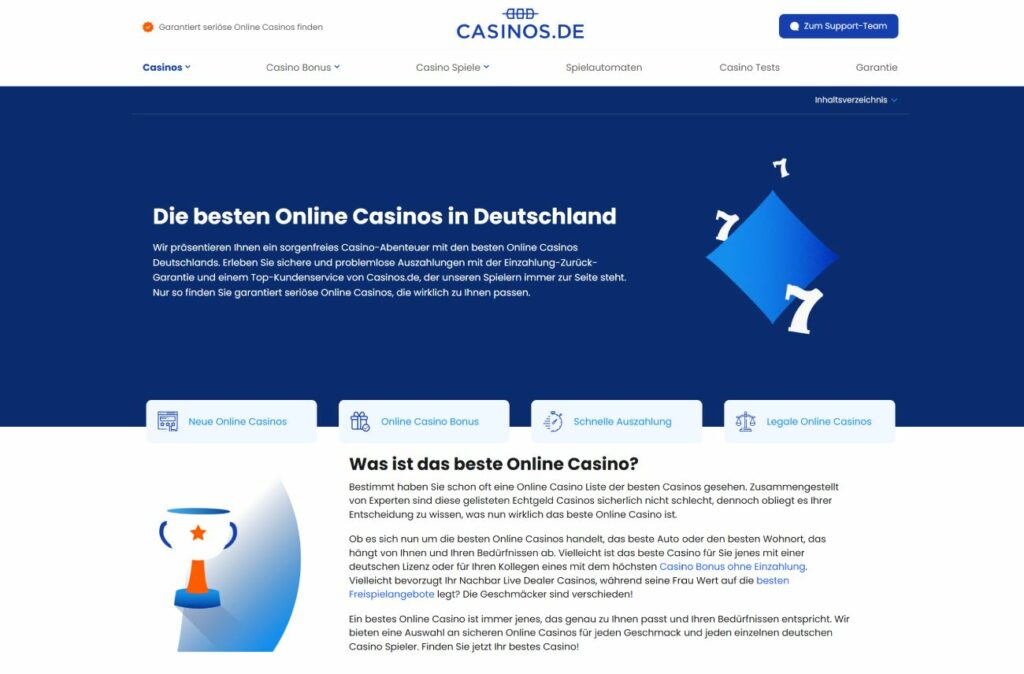
This is the story of how I worked with casinos.de, one of Germany’s established online casino comparison platforms, to build a sustainable organic growth engine in a market where nearly every other lever was off the table.
The Starting Point: A Market Where the Rules Are Different
Before getting into what we did, it’s worth understanding why this project was so different from a typical SEO engagement.
Every keyword is expensive – literally and figuratively. In most competitive niches, you can offset a slow organic ramp with paid search while you build authority. Not here. Online gambling advertising is tightly restricted on Google Ads in Germany, and in practice, running paid campaigns for casino-related terms wasn’t a viable path. That meant organic search wasn’t just one channel among several — it was, functionally, the entire acquisition strategy. Every ranking position had to be earned, not bought, and there was no paid safety net to fall back on if organic growth stalled.
Content is genuinely difficult to produce well. Casino and gambling content isn’t the kind of thing you can churn out by paraphrasing the top ten results. It requires precision around regulation, licensing, responsible gambling language, and factual accuracy about odds, bonuses, and terms — all while still being genuinely useful and readable for someone trying to make a decision. Thin or generic content doesn’t just underperform in this space; it actively works against you with Google’s quality systems.
The competitive set is relentless. Every major keyword in the German casino space is contested by well-funded affiliates, established comparison sites, and operators themselves, most of whom have been investing in SEO for years. There’s no easy long-tail entry point that competitors haven’t already found.
Taken together, this meant the strategy couldn’t rely on any single trick. It had to be a coordinated effort across content, technical SEO, site architecture, and off-page authority — running in parallel, and running well.
It also meant patience had to be built into the plan from day one. In lower-stakes verticals, it’s tempting to chase quick wins — a handful of long-tail pages that rank fast and pad the traffic numbers. In gambling SEO, quick wins are rare and often illusory; a page that spikes without the underlying quality and authority to support it tends to fall back just as fast, sometimes taking neighboring pages down with it if Google flags a quality issue site-wide. So the approach had to prioritize durability over speed — building a foundation strong enough that growth, once it came, would actually hold.
Building the Team and the Process
I worked as part of a dedicated SEO team with people who had spent years specifically in affiliate and performance-driven SEO — not generalists, but specialists who understood both the mechanics of search and the specific constraints of the gambling vertical. That mattered. A lot of the decisions we made only make sense if you’ve seen how this market behaves over multiple algorithm cycles.
My role sat at the intersection of content strategy, technical execution, and cross-functional collaboration — working closely with our Product Manager and Content Executives to shape what we published, and with our Outreach team to build the authority behind it.
Content Strategy: Research-Led, Not Guesswork
Given how costly it is to get content wrong in this space, we couldn’t afford to write based on intuition. We used Surfer SEO heavily as the backbone of our content research and optimization process.
In practice, this meant:
- Content briefs grounded in real ranking data. Before writing anything, we analyzed what was actually ranking for a given target keyword — structure, depth, semantic coverage, and the specific subtopics that top-performing pages consistently addressed.
- Closing content gaps competitors had missed. Surfer’s analysis let us spot where the existing top-ranking pages were thin or incomplete, which became our opportunity to genuinely add more value rather than just match what was already there.
- Iterating instead of publishing and forgetting. Content in this niche isn’t a one-and-done exercise. We treated existing pages as living assets, revisiting and strengthening them as competitors updated their own content and as our own performance data came in.
Crucially, this wasn’t a solo content effort. I worked directly with our Product Manager and Content Executives to make sure the strategy reflected both what the data was telling us and what actually made sense for the product and the user. SEO research can tell you what to cover; it takes a collaborative process to make sure it’s covered well and stays aligned with the brand and the offering.
That collaboration mattered most at the points where data and judgment could pull in different directions. Surfer’s recommendations are built from what’s currently ranking, which is useful, but “what’s currently ranking” isn’t always “what’s genuinely best for the reader” — especially in a niche where a lot of existing content is written to satisfy search engines first and users second. Part of my role was making sure we didn’t just replicate that pattern. Where the data pointed toward a certain structure or depth of coverage, the Content Executives brought the judgment on tone, clarity, and actually answering the questions a real person would have before choosing where to play. The Product Manager kept us honest about how content decisions tied back to the broader product and business goals, not just ranking potential in isolation. That three-way check — data, editorial judgment, and product context — is what kept the content strategy from drifting into either extreme: overly mechanical optimization on one side, or content that read well but underperformed on the other.
Site Architecture: Silos and Interlinking
One of the more structural pieces of the strategy was rebuilding how the site organized and connected its content. We designed and implemented a silo structure, grouping related content into clearly defined topical clusters rather than letting pages exist as isolated, loosely connected entries.
Alongside this, we built a deliberate internal interlinking strategy. Rather than relying on default navigation or ad hoc links, we mapped out how authority and relevance should flow between pages — linking supporting content up to core commercial pages, and linking related topics to each other in a way that reinforced topical relevance for search engines and made navigation more intuitive for users.
This combination did two things at once: it helped Google understand the depth and structure of our topical coverage, and it improved how link equity moved through the site, so that our most important commercial pages benefited from the authority being built across the wider content set.
Technical SEO: Auditing at Scale
Content and structure only work if the technical foundation is sound, so we ran continuous audits using Screaming Frog to crawl the site and surface issues that would otherwise quietly undermine everything else — broken links, indexation problems, duplicate content, redirect chains, and metadata issues.
We also kept a close eye on Core Web Vitals and site performance more broadly. In a competitive vertical, technical experience isn’t a nice-to-have — it’s a ranking factor and a user-trust factor at the same time. We treated page speed, stability, and interactivity metrics as ongoing priorities rather than a one-time fix, looking for continuous opportunities to shave load times and improve the experience, particularly on the commercial and comparison pages where user patience is thinnest.
Off-Page Strategy: Backlinks Built With Intent
With paid acquisition off the table, the authority we needed to compete had to come from somewhere else — and that meant a serious, deliberate backlink strategy.
I worked in close collaboration with our Outreach team to set and implement the off-page strategy for the products in our portfolio, including casinos.de. This wasn’t about volume for its own sake. In a niche as scrutinized as gambling, low-quality or spammy backlink profiles are a liability, not an asset. The focus was on building links from relevant, credible sources that would hold up under scrutiny and genuinely contribute to domain authority over time.
This off-page work ran in parallel with the on-page and technical efforts, so that as content quality and site structure improved, the external authority signals were building alongside it — rather than one lagging behind the other. That alignment was deliberate: a strong backlink profile pointing at thin or poorly structured content wastes the authority you’ve worked to build, and equally, great content with no external signal behind it struggles to break through against competitors who’ve been building authority for years. Keeping the two in step meant that every gain we made on one side was actually usable by the other.
Measurement: Watching Everything, Constantly
None of this works without tight feedback loops. We monitored performance continuously through Google Analytics and Google Search Console, tracking not just headline traffic numbers but the underlying signals: which pages were gaining or losing visibility, how click-through rates were shifting for key queries, where technical issues were starting to affect crawling or indexation, and how new content was performing against the briefs we’d built it from.
This constant monitoring meant the strategy wasn’t static. When something wasn’t working — a content cluster underperforming, a technical regression, a backlink source not moving the needle — we could catch it early and adjust, rather than finding out at the end of a quarter that something had quietly gone wrong.
The Outcome
Working across content, site architecture, technical SEO, and off-page authority — with organic search carrying the full weight of acquisition in a market where paid channels weren’t an option — we achieved ambitious yet realistic organic growth targets for casinos.de.
The results weren’t the product of any single tactic. They came from treating SEO in this vertical the way it needs to be treated: as a coordinated, ongoing discipline where content quality, technical health, site structure, and authority building all have to move together, monitored closely enough that problems get caught before they compound.

What This Project Reinforced
A few things stood out from this engagement that I’ve carried into how I approach SEO more broadly:
Constraints sharpen strategy. Not having paid search as a fallback forced a level of rigor in the organic strategy that’s easy to skip when there’s a safety net. Every piece of content, every technical fix, and every backlink had to actually earn its place.
Research beats intuition, especially in high-stakes content. Using data-driven tools like Surfer SEO to inform content briefs made the difference between guessing what would rank and knowing what genuinely needed to be covered — critical in a niche where getting content wrong has real consequences.
Structure is as important as content. A well-written page buried in a poorly organized site won’t perform the way it should. The silo and interlinking work was just as important to the results as the content itself.
SEO is a team sport. None of this happened in isolation. It took close collaboration with Product, Content, and Outreach to execute a strategy at this level — technical skill alone isn’t enough in a competitive vertical like this.
If you’re navigating a similarly constrained or competitive market and want to talk through how a coordinated SEO strategy might work for your business, feel free to reach out.