
Backlinks in SEO: Complete Overview
Navigate through the core foundations, quality evaluation, strategic approaches, and performance analytics of backlink building.
What Is a Backlink?
An incoming hyperlink from one website to another website acting as a vote of confidence or structural recommendation.
Hard to Fake at Scale
Unlike basic on-page optimization, earned independent citations require actual quality and cannot be easily fabricated.
Ranking Dominance
Understanding backlinks bridges the gap between languishing on page three and securing competitive page one rankings.
Domain Authority & Trust
Links from globally recognized or industry-trusted domains carry significantly more weight than unknown directories.
Contextual Relevance
Topical alignment is crucial. A link from a peer site in your exact niche is vastly superior to random unrelated placements.
Original Research
Publish proprietary industry surveys and data assets that other creators naturally cite in their own content.
Avoid Quantity Chasing
Steer clear of low-tier directories or spam schemes. Search engines easily discount volume and penalize manipulation.
Profile Auditing
Periodically monitor your backlink profile to detect and disavow malicious competitor spam links promptly.
Referring Domains Count
Monitor unique linking websites rather than raw link counts to ensure healthy domain network distribution.
Traffic & Rankings Correlation
Measure organic traffic increases on linked destination pages alongside position shifts for target keywords.
What Exactly Is a Backlink?
A backlink, sometimes called an “inbound link” or “incoming link,” is simply a hyperlink from one website that points to a page on another website. If a cooking blog links to your recipe article, or a travel magazine references your guide to hiking trails, that’s a backlink.
The Technical View
From a purely technical standpoint, a backlink is just HTML code — an anchor tag with an href attribute pointing to a URL.
The SEO Vote of Confidence
From an SEO standpoint, backlinks function as votes of confidence. When one site links to another, it implicitly says, “this content is worth referencing,” building trustworthiness and authority.
💡 The PageRank Revolution & Modern Search
This idea didn’t start with Google, but Google’s early success was built substantially on it. The company’s founders published a research paper describing PageRank, treating links between web pages like academic citations in scholarly papers. A page with many links from well-regarded sources was assumed more valuable. That foundational insight — using the web’s link graph as a proxy for quality — remains embedded in how modern search engines evaluate pages today.
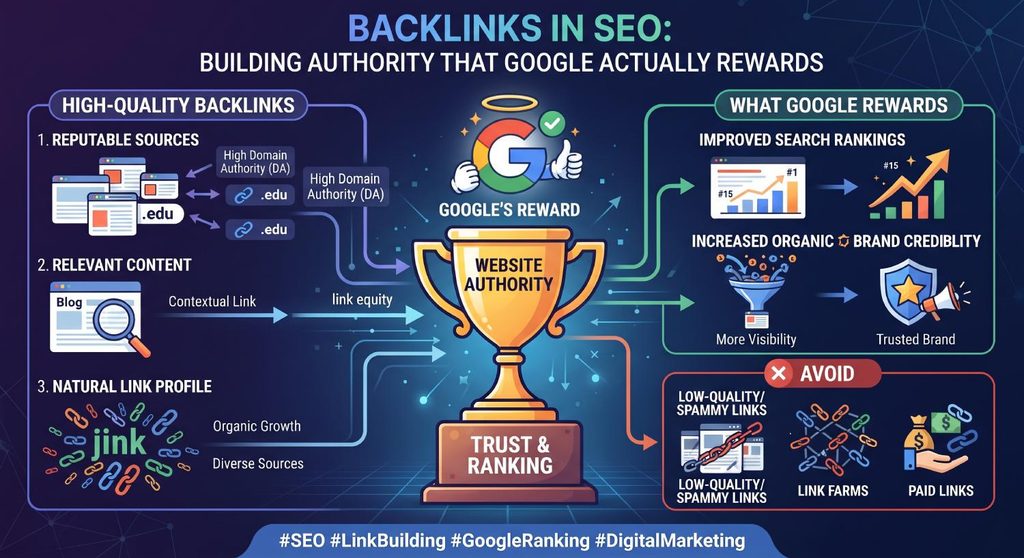
Why Backlinks Still Matter Today
Search algorithms have evolved enormously with content quality signals, user experience metrics, and AI-driven relevance models. Though some commentators declared “links are dead,” that prediction hasn’t held up. Backlinks remain a top-weighted ranking factor with a strong correlation across competitive keywords.
There are a few reasons backlinks have proven durable:
Hard to fake at scale
Anyone can stuff keywords or write optimized content. Getting an independent website to link to your page is much harder to manufacture, representing a human editorial decision that’s difficult to replicate.
A trust & popularity signal
A link from a relevant site signals both useful content and credibility within a network of authoritative sources, establishing powerful topical authority.
Drives real referral traffic
Setting aside SEO value, high-traffic backlinks send direct visitors to your page, bridging the gap between effective marketing, PR, and organic search visibility.
How Search Engines Evaluate Link Quality
Not all backlinks carry equal weight. A link from a globally recognized news outlet is treated very differently than a link buried in the footer of an obscure, low-traffic blog. Search engines use a range of signals to judge the quality of each link.
Domain authority and trust
While “Domain Authority” is technically a third-party metric, the underlying concept — that some domains carry more accumulated trust and link equity than others — is very real inside search engines’ ranking systems.
Relevance to your niche
A link from a site covering a closely related topic is worth more than an unrelated site. Topical alignment helps search engines weigh context and relevance accurately.
Anchor text optimization
Natural, varied anchor text looks organic. Overly optimized anchor text with exact keyword phrases repeated across dozens of links can trigger algorithmic penalties.
Placement on the page
A link embedded naturally within the body of an article, surrounded by relevant content, carries more weight than a link stuffed into a sidebar, footer, or resource list.
Follow versus nofollow attributes
Links tagged with “nofollow,” “sponsored,” or “ugc” serve as hints rather than strict directives. While they may still pass weight in certain cases, “dofollow” links remain more valuable.
Traffic and engagement on the linking page
A backlink placed on a page that receives organic traffic and engagement is more valuable than one sitting on an orphaned page nobody visits.
Diversity of referring domains
Ten links from ten different websites are worth more than ten links from the same website. A broad, diverse link profile signals wide-reaching brand recognition rather than isolated validation.
The Difference Between White Hat and Black Hat Link Building
Because backlinks are so influential, an entire industry has grown up around acquiring them — and not all of it is legitimate. Understanding the spectrum of tactics is essential because the wrong approach can do serious damage to a site’s rankings.
White Hat Link Building
Refers to techniques aligned with search engine guidelines, focusing on earning links through genuine value: original research, useful tools, thorough guides, and journalist outreach. These links are durable and low-risk.
Gray Hat Tactics
Sits in between — guest posting purely for links or arranged reciprocal link exchanges designed to game algorithms. While not as heavily punished as outright buying, they become less effective as algorithms improve.
Black Hat Link Building
Tactics designed to manipulate the link graph artificially — bulk link buying, private blog networks (PBNs), or automated spam. While yielding short-term gains, penalties range from devalued profiles to full manual removal.
The Ultimate Takeaway
The general lesson from over two decades of search engine evolution is that the safest and most durable link building strategy is also the most obvious one: create something genuinely worth linking to, and then make sure the right people know it exists.
Practical Strategies for Earning Quality Backlinks
Moving from theory to execution requires proven, white-hat methods to attract authoritative references without risking algorithmic penalties. Here are the most effective approaches for building a robust link profile:
Publishing Original Research & Data
Conducting industry surveys or analyzing proprietary data creates an asset that other journalists and writers naturally want to cite as a primary source.
Creating Free Interactive Tools
Building calculators, templates, or diagnostic widgets solves recurring problems for users, making it an irresistible resource for blogs to reference.
Strategic PR & Journalist Outreach
Platforms like Featured or HARO-style requests allow subject matter experts to provide commentary to journalists in exchange for high-authority media links.
Guest Contribution on Relevant Sites
Writing insightful, non-spammy educational content for reputable industry peers establishes brand footprint while securing contextual dofollow links.
The Role of Internal Linking
While external backlinks point from other domains to yours, internal links distribute that accumulated equity across your entire site structure.
Distributing Link Equity (PageRank)
When external authority flows to your homepage or top-tier guide, strategic internal linking channels that valuable link equity down to deeper product pages, category hubs, and conversion assets that need ranking momentum most.
Enhancing Crawl Efficiency
Search engine web crawlers discover new pages by following links. A clean internal link architecture ensures search bots can easily crawl and index your entire catalog.
Improving User Experience
Contextual links guide readers smoothly to related articles or deeper resources, increasing session duration and lowering bounce rates.
Establishing Topical Relevance
Anchor text used in internal links provides strong contextual hints to search engines regarding the subject matter of destination pages.
Competitor Backlink Gap Analysis
Uncover high-probability outreach opportunities by analyzing the exact websites linking to your market rivals.
Identify Top Rivals
Input your domain and your top three market competitors into professional SEO tools to map out overlapping and competing inbound link profiles.
Spot the Missing Links
Filter for referring domains that actively link to multiple competitors in your space but haven’t linked to your website yet, revealing immediate gaps.
Execute Targeted Outreach
Reach out to webmasters with tailored content pitches, showing how your resource provides fresh value or fills a blind spot in their existing coverage.
Common Backlink Building Mistakes to Avoid
Even well-intentioned link building efforts can go wrong. Watch out for these critical patterns:
Chasing quantity over quality
A handful of backlinks from genuinely relevant, respected sources will do more for your rankings than hundreds of low-quality links from irrelevant directories or spam sites. Search engines are adept at discounting low-quality links, so time spent chasing volume is often wasted.
Over-optimized anchor text
Repeatedly using the exact same keyword-rich anchor text across many links looks unnatural to search algorithms and can trigger scrutiny. A natural link profile includes a healthy mix of anchor text types.
Ignoring relevance
A backlink from a site that has nothing to do with your industry provides comparatively little value and, in aggregate, can even look suspicious if it’s part of a broader pattern.
Participating in link schemes
Paid link networks, excessive link exchanges, and automated link generation all violate most search engines’ guidelines and carry real risk of algorithmic or manual penalties.
Neglecting backlink profiles
Websites should periodically audit inbound links. Competitors occasionally build spammy links pointing to your site to trigger negative SEO penalties, making regular checks and disavowals essential.
Measuring the Impact of Your Backlink Efforts
Building links without measuring their effect is like running ads without tracking conversions. Keep an eye on these core metrics over time:
Referring domains
The total number of unique websites linking to you, which matters significantly more than raw link count. Tracking unique domains ensures you are building a broad network of authority rather than over-relying on single sources.
Organic traffic growth
Growth to the specific pages that have received new backlinks, which helps establish a rough correlation between link building activity and search visibility.
Keyword ranking movement
Tracking position shifts for terms most relevant to pages receiving links across major search engines to gauge true optimization performance.
Referral traffic
Traffic generated directly by the backlinks themselves, which serves as a valuable conversion and engagement signal independent of search engine rankings.
Domain-level authority
Scores provided by third-party tools, tracked over time as a general proxy for overall link equity and site strength, offering helpful trend visibility.
Final Thoughts
Backlinks remain one of the most durable and influential factors in how search engines evaluate the credibility of a website. But the underlying mechanics haven’t really changed since the earliest days of search: links are, at their core, endorsements. The sites that consistently earn high-quality backlinks are almost always the ones producing something genuinely worth referencing, and then making a reasonable effort to get that work in front of the people positioned to link to it.
Rather than treating backlinks as a checkbox to tick off during a technical SEO audit, it’s more useful to think of link building as an extension of good content strategy and genuine industry engagement.
Frequently Asked Questions
Everything you need to know about understanding, building, and measuring backlinks for SEO success.