
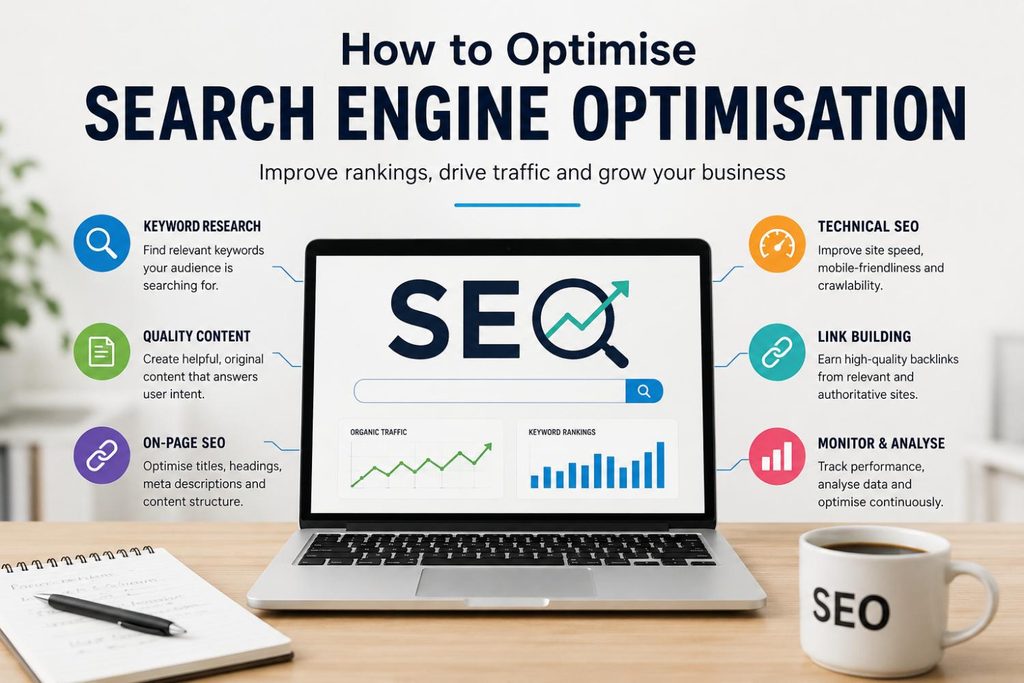
How to Optimise Search Engine Optimisation
Explore our comprehensive technical guides and masterclasses designed to scale organic traffic, improve authority, and maximize long-term search engine visibility.
Comprehensive Keyword Research
Uncover high-intent search terms, analyze competitor positioning, and build a foundational targeting map to capture valuable organic search traffic.
Authority & Backlinks
Master modern link-building strategies, secure high-authority placements, and build domain trust to rank competitively in search results.
Content Copywriting
Craft high-converting, search-optimized content that satisfies user intent, engages readers, and ranks organically for key terms.
SEO Landing Pages
Structure landing pages for maximum organic visibility, blending strong technical on-page optimization with compelling conversion pathways.
Canonical Tag Strategies
Prevent duplicate content issues and consolidate link equity efficiently using proper canonical tag frameworks and URL management.
XML Sitemaps & Crawling
Optimize crawl efficiency by structuring XML sitemaps, managing robots rules, and guiding search engine bots through site architecture.
International Hreflang Tags
Target global markets accurately by implementing hreflang attributes to serve the correct regional and linguistic versions of your pages.
Realistic SEO Timelines
Set accurate expectations for organic growth, tracking performance milestones from initial technical audits to top-tier search rankings.
Bottom-of-Funnel SEO
Capture high-converting purchase intent traffic by targeting commercial keywords that turn searchers directly into paying clients.
Evergreen SEO Strategy
Create timeless, high-performing assets that consistently drive organic traffic and compound in value over months and years.
Why Existing Websites Need a Different SEO Approach
A new website has no baggage. An existing website has history — and that history cuts both ways.
The Power of Historical Authority
An established site usually has some combination of aged domain authority, existing backlinks, indexed pages, and a track record with search engines that a brand-new site simply doesn’t have.
Google has crawled it before, has some sense of its trustworthiness, and may already be sending it traffic for a range of queries the site owner isn’t even aware of.
Accumulated Technical Debt
URLs get changed without redirects. Content gets published without a clear keyword strategy. Old pages compete with newer ones for the same search terms.
Plugins and page builders get layered on top of each other, slowing load times. None of this is fatal, but all of it adds friction that a fresh site wouldn’t have.
The Anatomy of High-Impact SEO
Explore how technical foundations, authority signals, and conversion architecture interact dynamically to compound organic visibility. Select a layer below to inspect the mechanics.
Technical Infrastructure & Crawl Efficiency
Before search engines can rank your pages, they must seamlessly discover, crawl, and index your architecture without roadblocks. Proper XML sitemaps, canonical tag frameworks, and clean URL routing protect your domain from duplicate content penalties and ensure maximum crawl budget allocation.
Content Copywriting & Search Intent
High rankings are a direct byproduct of matching user intent precisely. We build foundational keyword targeting maps and draft compelling evergreen assets that satisfy what searchers are looking for—fostering engagement, driving lower bounce rates, and building long-term compounding authority.
Authority & Backlink Architecture
Search engines weigh external trust signals heavily when deciding who occupies top positions. Our link-building frameworks secure high-authority contextual placements, strengthening domain equity and driving competitive keyword movement across tough commercial verticals.
International Hreflang & Scale
Expanding across borders requires precise linguistic and regional targeting. Implementing robust hreflang attributes ensures search engines serve the exact localized version of your content to users based on language preference and geographic region.
Bottom-of-Funnel Conversion Architecture
Traffic without revenue is just a vanity metric. By targeting high-intent commercial keywords and structuring friction-free landing pages, we connect organic visibility directly to pipeline generation and high-value customer acquisitions.
Step 1: Start With a Full SEO Audit
Before changing anything, you need a clear picture of where the site currently stands. An audit answers three core questions: what is the site currently ranking for, what technical issues might be suppressing performance, and where is the biggest gap between current performance and potential performance.
Search performance review
Pull data from Google Search Console covering at least the past 12 months. Look specifically for pages that rank on page two or three of search results — positions 11 through 30 — since these are often the fastest wins available.
A page ranking at position 15 is far easier to push into the top five than a page that doesn’t rank at all, because Google has already decided the content is relevant; it just needs reinforcement.
Traffic and engagement patterns
Cross-reference Search Console data with analytics data. Are there pages getting impressions but almost no clicks? That usually signals a weak title tag or meta description rather than a content problem.
Are there pages getting clicks but very high bounce rates? That often points to a mismatch between what the title promises and what the content delivers.
Content inventory
Create a full list of every indexed page, along with its target keyword (if any), word count, last update date, and current ranking position.
This inventory becomes the backbone of every decision you make going forward — which pages to update, which to consolidate, and which to remove entirely.
Technical health check
Crawl the site using a tool like Screaming Frog, Sitebulb, or Ahrefs’ site audit feature. You’re looking for broken links, duplicate title tags, missing meta descriptions, orphaned pages with no internal links pointing to them, and crawl errors.
These issues are rarely dramatic on their own, but in aggregate they tell search engines the site isn’t well maintained — and that perception matters.
Backlink profile review
Check which pages have the strongest backlink profiles and confirm those links are still active and pointing to the right destinations. It’s common on older sites to find valuable backlinks pointing to a page that was deleted or moved without a redirect, meaning the site is losing the SEO value of that link entirely.
Step 2: Fix the Technical Foundation First
Content improvements get more attention because they’re visible and satisfying to produce, but technical issues are frequently the reason good content underperforms. If the site has structural problems, even the best-written page may never rank the way it should.
Site speed
Page speed remains a ranking factor and, more importantly, a direct driver of user behavior — slower pages have measurably higher bounce rates.
Run the site through Google’s PageSpeed Insights or a similar tool and address the highest-impact issues first: unoptimized images, render-blocking scripts, and excessive third-party tags are usually the biggest offenders on older sites.
Mobile usability
Google indexes and ranks primarily based on the mobile version of a site.
If the existing site was built years ago with desktop as the priority, mobile usability issues — text too small, buttons too close together, content that doesn’t reflow properly — can be quietly suppressing rankings across the board.
Crawlability and indexation
Check the XML sitemap is current and submitted, confirm the robots.txt file isn’t accidentally blocking important sections, and review which pages are indexed versus which the site owner intends to be indexed.
It’s surprisingly common for older sites to have thin, low-value pages indexed and diluting quality signals, while useful pages sit unindexed due to a stray noindex tag.
Redirects and URL history
Any time URLs have changed — through a redesign, a CMS migration, or a restructuring of site architecture — there’s a risk of broken redirect chains or missing 301 redirects.
Audit for 404 errors and redirect loops, since both waste crawl budget and can strand backlink value that should be flowing to a live page.
Core Web Vitals
Google’s Core Web Vitals (Largest Contentful Paint, Interaction to Next Paint, and Cumulative Layout Shift) measure real-world loading, interactivity, and visual stability.
These are available directly in Search Console under the “Core Web Vitals” report and are worth checking specifically for pages that already generate meaningful traffic, since improvements there have outsized impact.
Step 3: Optimize Existing Content Before Creating New Content
One of the biggest mistakes on existing websites is treating new content as the default answer to flat or declining traffic. In reality, updating and improving what already exists is often faster, cheaper, and more effective — because those pages already have some authority and ranking history to build on.
Update outdated information
Any content referencing dates, statistics, prices, or “current” trends should be reviewed regularly.
Search engines have shown a consistent preference for freshness signals on topics where recency matters, and users bounce quickly from content that’s visibly out of date.
Expand thin content
Pages ranking in positions 10-30 are frequently thin relative to top-ranking competitors.
Compare the page directly against what’s currently ranking on page one for the same query — not to hit an arbitrary word count, but to identify subtopics, questions, or details the existing page fails to address.
Improve on-page SEO fundamentals
Revisit title tags, meta descriptions, header structure, and image alt text across the highest-opportunity pages.
Small changes here — a title tag rewritten to better match search intent, a meta description that improves click-through rate — often produce measurable gains within weeks, well before any content rewrite takes effect.
Consolidate overlapping content
Sites that have published for years frequently end up with multiple pages targeting the same or very similar keywords, unintentionally competing against each other — a problem known as keyword cannibalization.
Identify these clusters and either consolidate them into a single, stronger page (redirecting the weaker ones) or clearly differentiate them so each targets a distinct intent.
Remove or noindex low-value pages
Not every existing page deserves to be saved. Old, thin, or irrelevant content that isn’t earning traffic or serving users can drag down the perceived quality of the site as a whole.
Removing or noindexing genuinely low-value pages is a legitimate optimization strategy, not a loss.
Refresh internal linking
As a site grows, older content often gets buried without links from newer, more prominent pages.
Adding contextual internal links from high-traffic pages to relevant older content redistributes authority across the site and helps search engines rediscover pages they may have deprioritized.
Step 4: Realign Content With Current Search Intent
Search intent shifts over time, even for the same keyword. A term that once returned mostly blog-style explainer content might now return comparison tables, video content, or product listings, depending on how user behavior and Google’s understanding of the query have evolved.
Study current SERP dominance
For any page that has lost rankings without an obvious technical cause, search the target keyword directly and study what’s currently ranking.
Ask what format dominates the results, what subtopics are consistently covered, and what kind of page — informational, transactional, navigational — Google seems to be favoring for that query now.
Restructure for evolving intent
If the existing page no longer matches that intent, no amount of technical polish will fully fix it.
The content itself needs to be restructured to match what users (and Google) are now looking for.
Leverage structured data
This is also where structured data plays a role. Adding appropriate schema markup — FAQ schema, review schema, how-to schema, product schema — doesn’t change rankings directly.
However, it does improve how a page is represented in search results, which can meaningfully increase click-through rate even without any ranking movement.
Step 5: Strengthen the Backlink Profile Strategically
Existing websites usually already have some backlinks, which puts link building in a different position than it would be for a brand-new site. The priority shifts from acquiring any links at all to acquiring the right links and protecting the ones already in place.
Reclaim lost or broken links
Use a backlink tool to identify links pointing to 404 pages or old URLs that were never redirected.
Reaching out to those sites to update the link, or simply implementing a redirect, recovers value that’s currently being wasted.
Identify and disavow harmful links
Older sites sometimes accumulate low-quality or spammy backlinks over the years, whether from old directory submissions, negative SEO, or outdated link-building practices.
Reviewing the backlink profile periodically and disavowing genuinely toxic links protects the site from being unfairly penalized.
Pursue relevant, earned links going forward
Rather than broad outreach campaigns, focus on content that naturally attracts links — original research, useful tools, and genuinely comprehensive resources.
These tend to earn links organically over time far more reliably than direct outreach alone.
Leverage existing relationships and mentions
Search for unlinked brand mentions — places where the site or company is mentioned online without a corresponding hyperlink — and reach out to request the mention be linked.
This tends to have a notably higher success rate than cold outreach, since the connection already exists.
Step 6: Monitor, Measure, and Iterate
SEO on an existing website is never a one-time project — it’s an ongoing process of monitoring what’s working, catching what’s slipping, and adjusting accordingly.
Set a regular review cadence
Monthly is typical — for reviewing Search Console performance, tracking keyword position changes, and checking for any technical errors that may have emerged, particularly after any site updates, plugin changes, or redesigns.
Watch for sudden ranking drops that might indicate a technical issue versus gradual declines that might reflect a shift in search intent or increased competition.
Track downstream business metrics
It’s also worth tracking not just rankings but downstream metrics — organic traffic, conversion rate from organic visitors, and revenue or leads attributable to organic search.
Rankings alone don’t tell the full story of whether the optimization work is actually moving the business forward.
Common Mistakes to Avoid
A few patterns show up repeatedly when optimizing existing websites, and avoiding them saves considerable time and risk.
Making too many changes at once
When multiple significant changes — a content rewrite, a URL restructure, and a technical fix — are deployed simultaneously, and rankings shift afterward, it becomes very difficult to determine which change caused the movement.
Where possible, stage changes so their impact can be isolated and understood.
Changing URLs without redirects
This is one of the most damaging and most avoidable mistakes on existing sites.
Any URL change without a corresponding 301 redirect breaks both user experience and the flow of backlink authority to that page.
Chasing new content while ignoring the old
As covered above, it’s tempting to treat content creation as the primary lever for growth, but on an established site, updating and strengthening existing content is frequently the faster and more reliable path to improved performance.
Ignoring search intent shifts
A page that ranked well for years can quietly lose position not because anything about the page changed, but because what users expect from that query changed.
Periodically re-evaluating target keywords against current search results catches this before it becomes a larger problem.
Treating SEO as a one-time fix
Search engines’ algorithms, competitor behavior, and user expectations are all in constant motion. A site optimized once and left alone will gradually lose ground, not because the optimization was wrong, but because the environment around it kept changing.
Bringing It All Together
Optimizing SEO on an existing website is fundamentally a process of prioritization. There’s rarely a shortage of things that could be improved — the real skill is identifying which changes will move the needle fastest, and in what order to make them.
The tactical hierarchy
In practice, that generally means: audit first to understand the current state, fix technical issues that might be suppressing everything else, optimize and strengthen existing content before creating new content.
It also means realigning pages with current search intent where it has shifted, strengthening the backlink profile strategically rather than broadly, and building in a regular cadence of monitoring so problems get caught early rather than compounding unnoticed.
Unlocking existing momentum
Done well, this approach tends to produce faster and more durable results than starting an SEO strategy from scratch — because an existing website, despite its accumulated issues, already has something a brand-new site doesn’t: a track record.
The work isn’t about starting over. It’s about clearing away what’s holding that track record back.
Frequently Asked Questions About SEO
Get clear, actionable answers to the 10 most common questions regarding search engine optimisation, technical execution, and ranking timelines.
01
How long does it take to see results from SEO?
SEO is a compounding long-term channel. Typically, initial movement and indexing improvements appear within 3 to 6 months, while significant, highly profitable organic growth and top-tier rankings usually materialize between 6 to 12 months depending on competition and domain authority.
02
What is the difference between on-page and off-page SEO?
On-page SEO refers to optimizations made directly within your website (such as content quality, keyword usage, meta tags, and technical structure). Off-page SEO involves external signals that build your authority, primarily high-quality backlinks from other reputable websites.
03
Why are canonical tags important for my website?
Canonical tags tell search engines which URL is the master version when multiple pages have similar or identical content. They prevent duplicate content penalties and ensure that link equity and ranking power are concentrated onto your preferred landing pages.
04
How do I choose the right keywords to target?
Effective keyword research balances search volume, ranking difficulty, and commercial intent. Prioritize terms your target audience uses when they are actively looking to solve a problem or purchase a solution, focusing heavily on bottom-of-funnel queries for faster ROI.
05
What role do XML sitemaps play in technical SEO?
An XML sitemap acts as a roadmap for search engine crawlers, listing all important URLs on your site that should be indexed. It helps search bots discover new or updated content quickly, especially on larger or complex websites.
06
When should I implement hreflang tags?
You should implement hreflang tags whenever your website serves multiple languages or targets different geographical regions with localized content. This ensures search engines serve the correct regional version to users based on their language and location settings.
07
Why is bottom-of-funnel SEO crucial for conversions?
Bottom-of-funnel SEO targets users who are ready to buy or partner with an agency. While search volumes are lower than broad informational queries, conversion rates are exponentially higher because searchers have immediate commercial intent.
08
What makes an SEO copywriting strategy successful?
Successful SEO copywriting seamlessly blends search intent optimization with compelling, engaging prose. It satisfies what the user is looking for structurally while keeping readers hooked, reducing bounce rates, and driving clear conversion actions.
09
How do evergreen content assets build long-term value?
Evergreen content focuses on timeless topics that remain relevant year after year. Unlike trendy news pieces, evergreen assets continually attract organic search traffic, accumulate authority, and compound in value over long periods.
10
How should I prioritize tasks on an existing website?
Always start with a comprehensive technical audit to clear out blockers suppressing your rankings. Next, optimize existing pages and realign them with modern search intent before investing heavily in creating brand new content from scratch.