
SEO Silos: How to Structure a
Website That Actually Ranks
If your internal structure is a messy web where everything links to everything, Google can’t determine your topical authority. Silo architecture fixes that.
Mastering internal linking and topical clustering to signal clear expertise to search engines, executed with precision across international markets. 🚀✨
How an SEO Silo Actually Works
Think of a content silo less like a rigid folder system and more as a self-contained neighborhood. Each community has its own central hub, dedicated local streets, and tightly bound relationships.
“Best Museums in [City]”
“Public Transit & Getting Around”
“Free & Cheap Things to Do”
“Where to Stay: Neighborhood Guide”
“[City] Itinerary: 3 Days”
Upward & Lateral Flow
Every cluster page links securely back up to the pillar page, passing authority upward. Meanwhile, sibling pages link sideways to closely related topics (like transit connecting directly to museums).
Topical Relevance Signals
When multiple tightly related pages interlink with descriptive anchor text, Google gets an unambiguous signal that your domain possesses structured, deep authority on that exact subject matter.
Restraint Across Borders
Silos prevent link juice from leaking. You avoid random cross-linking between unrelated topics, reserving bridges strictly for occasional, highly relevant contextual references.
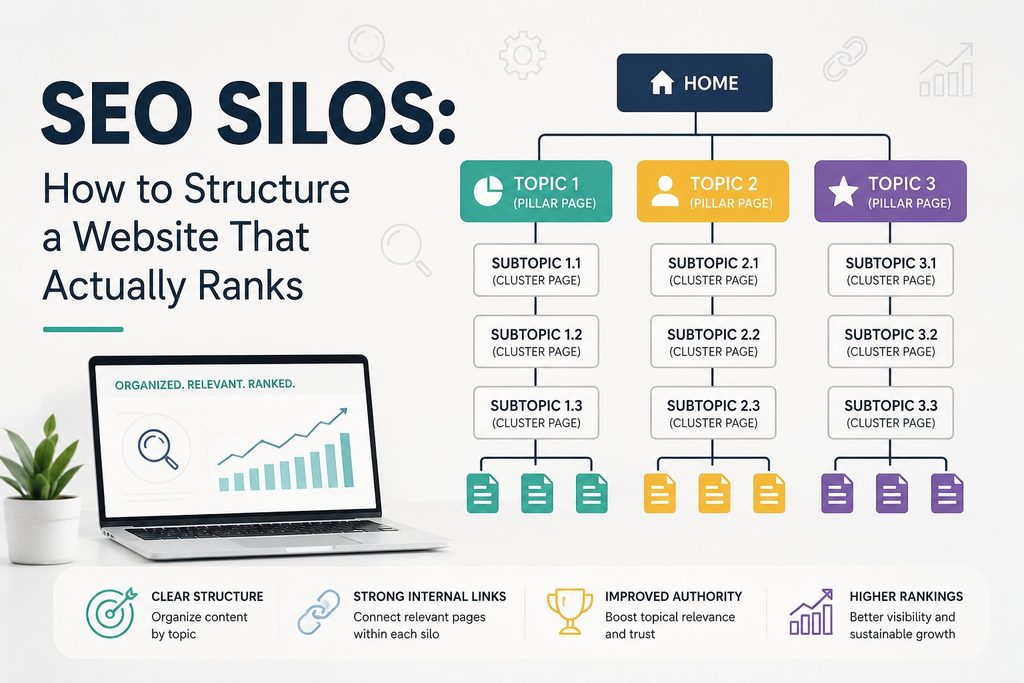
What a Silo Actually Is
A content silo is a way of organizing a website so that related pages are grouped together and interlinked tightly, while unrelated topics are kept structurally separate.
Think of it less as a folder system and more as a set of self-contained neighborhoods, each with its own internal roads, and only a few bridges connecting one neighborhood to the next.
There are two flavors of silo, and conflating them is where a lot of confusion starts:
Physical Silos
Built into the URL structure itself. A page about “hiking boots” sits under /gear/hiking-boots/, and everything under /gear/ is thematically related. The folder hierarchy mirrors the topical hierarchy.
Virtual Silos
Achieve the same grouping purely through internal linking, regardless of URL structure. Pages can live anywhere in the folder tree, but the way they link to each other creates the same topical clusters. This is closer to what most modern SEOs mean when they say “silo” — and it’s the more flexible, more commonly used approach today, partly because it doesn’t require restructuring your CMS or breaking existing URLs.
Why Silos Work: The Theory Behind the Tactic
Search engines don’t read a page in isolation. They read it in the context of everything that links to it, everything it links to, and the words used in those links.
A silo takes advantage of three things Google’s ranking systems actually care about:
Topical Relevance Signals
When ten pages about “email marketing automation” all interlink with descriptive anchor text, Google gets a much stronger signal that your site has deep, structured expertise on that topic — as opposed to one isolated article floating in a sea of unrelated content.
Link Equity Distribution
PageRank (and its many descendants in modern ranking systems) flows through links. A silo concentrates that flow within a topic cluster instead of leaking it out to unrelated pages, which means your most important “money pages” get reinforced by every supporting article underneath them.
Crawl Efficiency
Search engine crawlers have a limited budget for how much of your site they’ll bother crawling, especially on larger sites. A logical structure with clear pathways helps crawlers discover and re-crawl your important pages faster, instead of wasting budget wandering through orphaned or loosely connected content.
Anatomy of a Silo
Every silo has three components, and understanding the role each one plays makes the rest of this guide much easier to apply.
1. The Pillar Page
This is the broad, high-level page that defines the topic. If your silo is about “content marketing,” the pillar page targets that head term and gives a comprehensive overview, linking out to every subtopic underneath it. Pillar pages are usually the pages you most want to rank for competitive, high-volume keywords.
2. Cluster Pages (Supporting Content)
These are the narrower, more specific articles that live underneath the pillar — “content marketing for SaaS,” “how to repurpose blog content,” “content marketing budget templates.” Each targets a longer-tail keyword, and each links back up to the pillar page and sideways to its siblings.
3. Internal Links Reinforcing Hierarchy
This is the connective tissue, and it’s the part people get wrong most often. It’s not enough to create the pages — the links between them have to follow a deliberate pattern:
- Cluster pages link up to the pillar page
- The pillar page links down to every cluster page
- Cluster pages link sideways to closely related cluster pages within the same silo
- Pages in one silo generally don’t link sideways into a different silo, except through the pillar pages or a small number of deliberate crosslinks
Planning a Silo From Scratch
A step-by-step framework for mapping, structuring, and launching content silos that build real topical authority.
Keyword Research First
Pull keyword data around your core topic and group it by search intent and semantic similarity. Automated clustering groups by surface-level overlap, so combine it with manual review to match real reader navigation.
Map the Hierarchy
Sketch your pillar topic at the top and cluster topics branching below. Aim for six to fifteen cluster pages per pillar to ensure genuine topical depth without making the silo too granular.
Design URL Structure
For physical silos, set clean folder structures (e.g., /topic-a/subtopic-1/) before publishing. Retrofitting URLs later requires redirects that cost equity and crawl clarity.
Write Pillar Pages Last
Draft or outline your cluster content first. Then write the pillar page as a comprehensive connective overview that links to each piece using descriptive, varied anchor text.
Deliberate Internal Links
Ensure every cluster page links up to the pillar, sideways to 2–4 sibling pages, and uses descriptive anchor text. The pillar page should link down to every cluster right near the top.
Interlink With Restraint
Don’t wall silos off completely, but keep cross-silo links occasional and contextual. Avoid diffuse linking that dilutes the topical signal each silo is trying to send.
A Real Example: Silo Structure in Practice
It’s easier to see how this works with a concrete case rather than an abstract one. Take a travel content site built around city guides — say, a set of articles aimed at tourists visiting a specific European city.
Internal Linking Mechanics
Every cluster page links back to the main city guide. The transit article links naturally to the museums article (since a reader planning a museum visit needs to know how to get there), and the itinerary page links to nearly everything, since it’s functionally a curated summary of the whole silo.
Cross-Silo Boundaries
What it doesn’t do is link heavily into an entirely separate city’s silo, except maybe a single “if you’re also visiting [nearby city], here’s our guide” link — a deliberate, occasional bridge rather than a constant one.
Common Mistakes That Undermine Silo Structures
Even with the best intentions, it’s easy to make structural missteps that dilute your SEO signals. Here are the most frequent traps to watch out for.
Skipping Linking Discipline
People create folders, publish content, and then link however feels natural in the moment — usually linking to whatever’s most prominent in the CMS, not what supports the silo. Structure without deliberate internal linking is just a filing system, not an SEO strategy.
Making Pillar Pages Too Thin
A pillar page that’s 400 words with a bulleted list of links isn’t doing its job. It needs enough original content to be genuinely useful and rankable on its own, in addition to serving as a hub. Treat it as a real piece of content, not just a table of contents with a headline.
Over-Siloing & Orphan Content
Some webmasters get so strict about not cross-linking that they end up with pages nobody outside the silo finds, and pages that would genuinely help each other topically never get connected. Silo discipline is a guideline for concentrating relevance, not a hard rule that overrides utility.
Ignoring Navigation & Footer Links
Global navigation elements that appear on every page — main menus, footers, sidebars — can quietly undermine a silo if they link indiscriminately across the whole site. If every page links to fifty other pages regardless of topic, that dilutes the very separation you built.
Relying Solely on URL Structure
Physical silos (clean folder structures) feel like they should be enough, but URL structure alone carries a fairly weak signal compared to actual internal linking patterns. A site can have a beautifully organized hierarchy and still function poorly if the links between pages don’t reinforce it.
Forgetting Sideways Links
Many sites get the up-link (cluster to pillar) right and stop there, missing the lateral links between sibling pages that make the topical cluster feel genuinely interconnected rather than just a hub-and-spoke with no spokes touching each other.
Measuring Whether It’s Working
Once a silo is live, give it time — internal linking changes typically take weeks rather than days to show measurable effect, since crawlers need to re-crawl and re-evaluate the affected pages.
A few things worth tracking:
Rankings for the Pillar Keyword
Track how your main keyword rankings shift relative to before the silo was built or reorganized.
Aggregate Organic Traffic
Monitor traffic to the whole cluster, not just the pillar page, since a well-functioning silo often lifts the long-tail pages too.
Crawl Stats in Search Console
Check whether cluster pages are being crawled and indexed promptly after publishing, or sitting in limbo.
Internal Click Paths
Use analytics to see whether real users are actually following the linking structure you built, or bypassing it entirely through search or external links.
Differentiating Silos From Topic Clusters
Evaluating modern framework paradigms that organize related web properties, landing experiences, and journal entries beneath overarching subject categories.
The cluster methodology serves as a viable alternative framework to traditional categorical partitioning. Each hub operates around a central authoritative resource designed to supply an extensive summary before directing visitors toward related pages.
Both frameworks segment digital properties into defined niches to establish domain expertise and thought leadership. Because of these overlapping foundational goals, practitioners frequently conflate the two concepts — though a critical structural variance separates them regarding cross-communication rules.
Bringing It Together
Silo structure isn’t a trick or a loophole — it’s really just applied information architecture, done with search engines’ crawling and ranking behavior in mind as well as the reader’s.
Topical Depth & Organization
The sites that benefit most from silos are the ones with genuine topical depth to organize: a real body of content about a real subject, arranged so that both crawlers and readers can find their way from a broad overview down into specific, useful detail, and back out again.
Discipline & Execution
Get the keyword research right, keep the hierarchy honest — not too shallow, not artificially padded — and put real discipline into the internal linking. That last part is where almost all of the actual SEO benefit lives, and it’s the part that’s most tempting to half-do.
10 Most Common Questions About SEO Silos
Everything you need to know about structuring your website content, building topical authority, and optimizing your internal linking strategy.
What is an SEO silo and why is it important?
An SEO silo is a way of organizing a website so that related pages are grouped together and interlinked tightly, while unrelated topics are kept structurally separate. It helps search engines understand your topical expertise, distributes link equity effectively, and improves crawl efficiency.
What is the difference between physical and virtual silos?
Physical silos are built into the actual URL structure (e.g., folder hierarchies like /gear/hiking-boots/), whereas virtual silos achieve topical grouping purely through a disciplined internal linking strategy regardless of URL paths.
What are the core components of an SEO silo?
Every silo consists of three components: a broad pillar page targeting high-volume head terms, narrower cluster pages (supporting content) targeting long-tail keywords, and a deliberate internal linking pattern connecting them.
How should internal links be structured inside a silo?
Cluster pages must link up to their pillar page, the pillar page must link down to every cluster page, and sibling cluster pages should link sideways to closely related topics within the same silo while avoiding cross-linking into separate silos.
Can I cross-link between different silos?
Pages in one silo generally should not link sideways into a completely different silo. Cross-linking should be restricted to pillar pages or occasional, highly relevant contextual bridges (such as connecting a city guide to a neighboring city).
What are the most common mistakes people make with silos?
Common pitfalls include building folder structures without maintaining strict internal linking discipline, writing thin pillar pages, over-siloing to the point of creating orphan content, and ignoring how global menus or footers dilute topical boundaries.
How long does it take for an SEO silo to show results?
Internal linking and structural changes typically take weeks rather than days to show measurable effects. Search engine crawlers need time to re-crawl and re-evaluate the affected pages and update their ranking signals.
What metrics should I track to measure silo success?
Monitor rankings for your pillar keywords, aggregate organic traffic across the entire cluster (including long-tail pages), review crawl stats in Search Console, and track internal user click paths via analytics.
Why isn’t my pillar page ranking even though my cluster pages are?
This is usually a sign that your pillar page itself is too thin or lacks substantive, original content. A pillar page needs to be a robust, rankable standalone resource, not just a glorified table of contents pointing to other articles.
Are silos a one-time setup or do they require maintenance?
Silos require ongoing maintenance. As you publish new cluster pages, older articles must be updated to link to the new additions, and your pillar pages must evolve to reflect the expanding scope of the topic.