
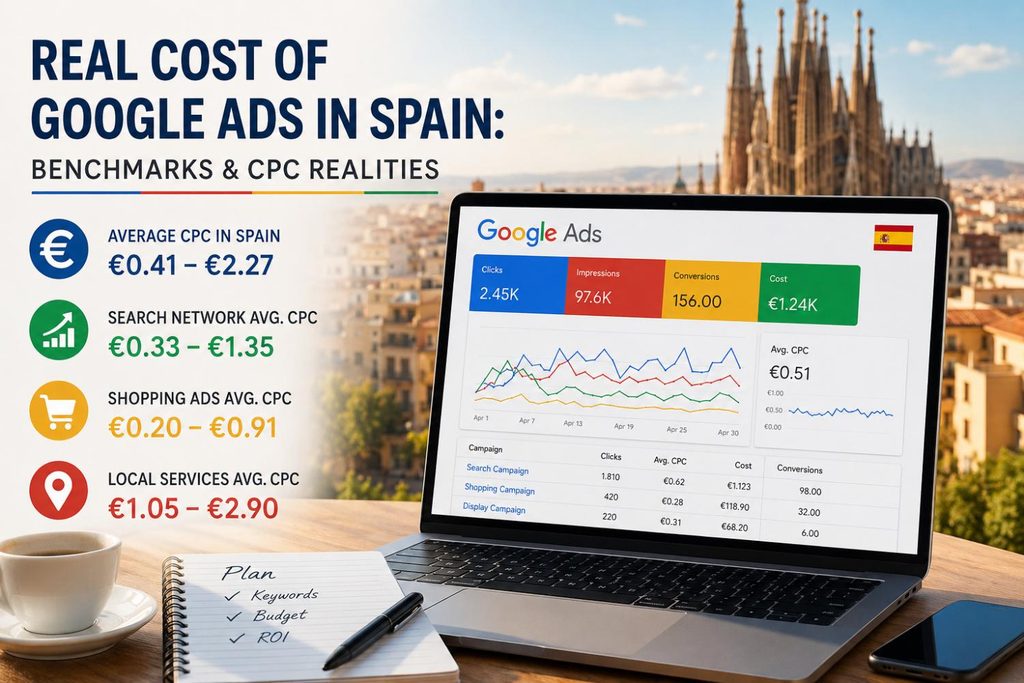
Real Cost of Google Ads in Spain:
Benchmarks & CPC Realities
Ask five agencies what Google Ads costs in Spain and you’ll get five answers. CPC stretches from a few cents to €25+ for high-intent queries like “abogado accidente tráfico Madrid”.
Whether targeting Valencia, scaling nationwide, or pitching clients, move past vague estimates into actionable data, real CPC ranges, and defensible budget frameworks. 📊💡
Key Takeaways
The essential insights and strategic benchmarks you need before launching or scaling Google Ads campaigns in the Spanish market.
Wide CPC Variance
Costs stretch from €0.30 for tourism and e-commerce up to €15–25+ for competitive legal and insurance search terms in Madrid and Barcelona.
50% Cheaper Than US
Spain offers a balanced mid-range pricing environment that sits significantly below Tier-1 English-speaking markets like the US and UK.
CPA Backward Planning
Top-performing advertisers calculate budgets starting from customer lifetime value and conversion rates rather than guessing at CPC averages.
The Foundation for Success
Avoiding early mistakes—like underfunding the test phase, skipping negative keyword lists, or ignoring Quality Score—ensures sustainable growth in Spain.
Google Ads CPC Price Ranges in Spain
A comparative visual breakdown of average cost-per-click thresholds across Spanish industries, highlighting the gap between affordable traffic and high-ticket service verticals.
The Golden Rule of Bidding
The visual disparity above directly reflects the core economic rule of Google Ads: the more a single conversion is worth to the business, the higher the CPC ceiling becomes.
Why “Average CPC in Spain” Is a Misleading Number
Before diving into figures, it’s worth being blunt about a common trap: headline CPC averages. You’ll often see a stat like “the average CPC in Spain is around €0.99” presented as if it tells you something useful. It doesn’t, really — not on its own.
Value of the Click
How much is a converted customer worth? Insurance and legal leads can be worth thousands of euros, allowing rational bids of €10+ per click. A restaurant ticket of €25–50 makes a €3 CPC financial suicide.
Serious Competitors
Spain has a smaller advertiser pool than the US or UK for most verticals, which is part of why CPCs tend to run lower — though competition still varies enormously by city and niche.
Quality Score Impact
Google isn’t a pure highest-bid auction. A well-optimized account with strong Quality Scores can pay significantly less than a mediocre account bidding on the exact same keyword, sometimes by 30–50%.
The Reality of National Averages
Averages are calculated across dozens of industries with wildly different economics. A blog running Display remarketing at €0.15 a click and a personal injury lawyer paying €12 both get folded into the same national average, describing no one’s actual campaign.
Google Ads CPC Benchmarks in Spain, by Industry
Planning ranges reported across Spanish digital marketing agencies and benchmark trackers. Actual CPC depends on geography, keyword specificity, and account quality.
Legal Services (Abogados)
At the top of the CPC ladder in Spain. Traffic accidents, divorce, and immigration law routinely climb past €12–15, with hyper-competitive terms exceeding €20–25 due to massive client lifetime value.
Insurance (Seguros)
High lifetime value and renewal potential push advertisers to bid up relevant terms, from “seguro coche barato” to online home policies.
Financial Services
Loans, mortgages, and investments dominated by well-funded national players who set a high price floor for high-value leads.
Real Estate (Inmobiliaria)
Residential search terms experiencing upward pressure driven by renewed demand and tight housing markets in Madrid and Barcelona.
Healthcare & Clinics
Dental, aesthetic, and private medical. Dental implants sit at the expensive €5–8+ end of local-service keywords because of high treatment value.
Home Services
Plumbers, locksmiths, and renovations. Locksmiths and emergency plumbing run at the higher end due to urgent, high-intent user queries.
E-Commerce
Affordable Shopping and Search campaigns combined, varying widely by product category and retail margin.
Restaurants & Hospitality
Lower competition and modest per-customer value keep cost-per-click thresholds minimal.
Education & Training
Demonstrating dynamic shifts, education CPCs fell sharply by 20%+ year-over-year in datasets, proving benchmarks are never static.
Tourism & Travel
Enormous variance between generic destination queries like “hoteles Madrid” and high-intent monument ticket bookings.
Spain in a European and Global Context
One consistent finding across benchmark sources is that Spain sits squarely in the mid-range of global Google Ads pricing — significantly cheaper than the US, UK, or Australia, but pricier than emerging Latin American or Eastern European markets.
The Mid-Range Position
Spain offers a balanced advertising landscape — meaningfully cheaper than Tier-1 English-speaking nations, yet mature enough to ensure high-intent B2B and consumer conversion quality.
50% Lower Average CPC
The gap between Spain and the US reaches roughly 50% lower average CPCs, meaning identical marketing budgets stretch considerably further domestically for Spanish SMEs and agencies.
Madrid & Barcelona Density
Geography matters immensely. Bidding in Madrid or Barcelona means competing against a much denser advertiser field, driving noticeably higher CPCs than mid-sized provincial capitals.
Cross-Market Perspective for Agencies
If you manage both Spanish and international accounts, campaigns that look “expensive” by Spanish domestic standards often represent an exceptional bargain in cross-market comparisons. 🚀
What Actually Moves Your CPC (Beyond Industry Averages)
Industry benchmarks are a starting point, not a destination. Within any given sector, individual advertisers see dramatically different real-world costs based on controllable factors.
Quality Score Optimization
Rated 1–10, Quality Score blends expected CTR, ad relevance, and landing page experience. An account with 8–10 can pay roughly half what a score of 4 pays for the exact same keyword in the same auction.
Keyword Specificity
Broad terms are expensive and inefficient. “Abogado” is brutal to compete on, whereas “abogado herencias sin testamento Valencia” is cheaper, more targeted, and converts at a much higher rate.
Match Type & Structure
Broad match accumulates low-intent clicks and inflates CPCs, while tightly controlled phrase and exact match campaigns paired with negative keyword lists produce predictable costs per click.
Device & Time of Day Swings
Mobile and desktop CPCs diverge frequently. B2B industries often see cheaper clicks outside business hours when competition from advertisers running restricted budgets drops off.
Ad Extensions & PMax Adoption
Automated bidding strategies (Target CPA, Max Conversions, Performance Max) access placements manual campaigns can’t, cutting both ways depending on conversion tracking setup.
Translating CPC Into a Realistic Monthly Budget
Once you know your likely CPC range, the next step is translating that into a media budget that actually generates usable data without underinvesting or burning fees.
€300 – €500 / month
The practical floor for a small business to gather meaningful data. Below €200/month, automated bidding algorithms lack sufficient signal volume to optimize delivery effectively.
€500 – €1,000+ / month
For legal, insurance, or private healthcare sectors. Higher per-click costs eat into smaller budgets fast, preventing accumulation of the 30–40 monthly conversions needed for automated bidding.
15% – 20% or Flat Fee
Expect management fees of roughly 15–20% of ad spend (or €300–€600/month for small accounts). Budget for this separately so a €500 media budget with a 20% fee totals closer to €600.
Working Backward From Cost Per Acquisition
CPA = CPC ÷ Conversion Rate
If your sector average CPC is €3 and your landing page converts at 5%, your lead cost is roughly €60. The question isn’t whether €3 is a good CPC in isolation, but whether a €60 acquisition makes sense given customer value.
Seasonality and Campaign Type: The Variables Benchmarks Don’t Show
Static industry averages hide two dimensions that matter enormously in practice: when you’re advertising, and what kind of campaign you’re running.
Seasonality & Calendar Impact
Retail CPCs climb 20–40% around Black Friday and Christmas. Travel destinations like Barcelona or Madrid see summer spikes for hotel terms, while legal and financial services experience predictable tax-season bumps.
Search vs. Display CPCs
Search campaigns capture high-intent moments and carry the highest CPCs. Display campaigns run 70–85% cheaper because traffic is lower-intent, reaching people reading news rather than actively searching.
Performance Max Dynamics
PMax blends Search, Display, YouTube, and Shopping into a single automated campaign, producing a blended CPC that sits between pure channels and shifts based on Google’s budget allocation.
Why Campaign Type Context Matters
Being quoted a “€3 average CPC” without knowing the campaign type hides two very different realities: a Search-only campaign targeting high-intent queries versus a PMax campaign averaging €3 across a broad, lower-intent mix. Always ask which campaign type a benchmark reflects before applying it. 🚀
Common Budgeting Mistakes Spanish Advertisers Make
A few patterns show up repeatedly among businesses new to Google Ads in the Spanish market, and they’re worth naming directly.
Fixating on CPC Instead of CPA
A cheap click that never converts is worse than an expensive click that does. Campaigns optimized purely to minimize CPC often pull in low-intent traffic that tanks conversion rates, leaving a worse overall cost per customer.
Underfunding the Test Phase
Launching with €150/month and expecting reliable data within two weeks leads many to conclude Google Ads “doesn’t work.” In reality, accounts need sufficient spend and conversion volume for systems to learn.
Ignoring Geographic Precision
Bidding nationally when your business only serves one city inflates spend without adding relevant traffic — an expensive default setting that goes unchecked in quickly setup accounts.
Skipping Negative Keywords
In competitive verticals like legal and home services, missing negative lists burn budget on searches like “cursos de fontanería” for a plumbing business rather than someone looking to hire one.
Comparing CPC Across Unrelated Benchmarks
Pulling global average CPC figures (often in USD, skewed heavily by expensive US verticals like legal and insurance) and applying them directly to a Spanish e-commerce budget produces wildly unrealistic expectations. 🚀
A Practical Framework for Setting Your Own Budget
If you’re planning a Google Ads budget for the Spanish market right now, follow this workable sequence to calculate your media investment accurately.
Identify Your Specific Niche Range
Look beyond broad categories to realistic target keywords. CPCs can vary two- or three-fold within a single industry depending entirely on keyword specificity and user intent.
Estimate Realistic Conversion Rates
Spain’s cross-industry average sits around 3.7–4.5%. Service businesses with clear calls-to-action convert higher, while e-commerce with longer decision cycles typically converts lower.
Calculate Target CPA vs Customer Value
Determine what a customer is worth and keep acquisition cost under a benchmark of roughly 20–30% of that value, adjusting for your specific profit margins and repeat purchases.
Back Into a Monthly Budget
Formula: (Target Conversions) × (Estimated CPC ÷ Conversion Rate). Want 20 leads at a €3 CPC with a 5% conversion rate? You need roughly €1,200 in monthly ad spend plus management fees.
05. Treat Month One as Data Gathering
Real optimization — trimming bad keywords, refining copy, and boosting Quality Score — only becomes possible once an account accumulates enough conversion volume, generally after two to four weeks of consistent spend. 🚀
The Bottom Line
There is no single “real cost” of Google Ads in Spain—there’s a real cost for your specific sector, geography, and keyword strategy.
Customer Value First
Costs can only be estimated meaningfully once framed around what a converted customer is actually worth to your business.
The Spanish Advantage
Spain’s mid-range position globally is a genuine advantage—costs sit well below the US and UK—though underfunding or poor targeting erases this quickly.
High-Performers’ Playbook
Top businesses budget from CPA backward, fund tests properly to gather real data, and treat Quality Score as a core growth lever.
Mastering the Ecosystem
Get those three core elements right, and the “real cost” of Google Ads in Spain tends to look a lot more manageable than the scarier end of the benchmark ranges.
Frequently Asked Questions
Everything you need to know about Google Ads benchmarks, CPC realities, and budgeting strategies in the Spanish market.
01 What is the average Cost-Per-Click (CPC) for Google Ads in Spain?
There is no single universal average. CPCs vary heavily by industry, ranging from €0.20–€1.50 for tourism, retail e-commerce, and hospitality up to €4–€15+ for highly competitive sectors like legal services (abogados) and insurance.
02 Why are legal services (abogados) so expensive on Google Ads in Spain?
Legal services sit at the very top of the CPC ladder (€4–€15+ for standard terms, and over €20 for hyper-competitive niches) because a single converted client—such as a traffic accident or divorce case—can be worth thousands of euros in fees.
03 How do Spanish CPC benchmarks compare to the United States or UK?
Spain offers a significantly more affordable advertising landscape. Average CPCs in Spain can run roughly 50% lower compared to Tier-1 English-speaking markets like the United States for equivalent competitive search verticals.
04 What role does geography play in Spanish Google Ads pricing?
Geography matters immensely. Bidding in major metropolitan hubs like Madrid or Barcelona means competing against a denser pool of high-budget advertisers, which frequently elevates your actual CPCs compared to smaller regional cities.
05 What is the “Golden Rule” of Google Ads budgeting?
The more a single conversion is worth to the business, the higher the CPC ceiling becomes. Advertisers can rationally keep bidding up until their customer acquisition cost approaches the total value of the customer.
06 How does Quality Score impact my actual cost per click?
Google Ads is not a pure highest-bid auction. A well-optimized account with a high Quality Score (blending expected CTR, ad relevance, and landing page experience) can secure better ad placements at a fraction of the cost.
07 What is a realistic monthly starting budget for a small business in Spain?
A practical floor is €300 to €500 per month. Anything below €200 per month starves automated bidding algorithms of sufficient data, making it virtually impossible to optimize campaigns reliably.
08 How do I calculate my target Cost Per Acquisition (CPA)?
Use the core formula: $\text{CPA} = \text{CPC} / \text{Conversion Rate}$. If your average CPC is €3 and your landing page converts at 5%, your lead cost calculates out to roughly €60.
09 Why are e-commerce and hospitality CPCs so low in Spain?
Retail e-commerce and restaurants/hospitality generally run between €0.30 and €1.50 per click. This reflects both a lower per-customer transaction value and a different competitive bidding density compared to high-ticket service verticals.
10 What are the most common budgeting mistakes beginners make?
Common pitfalls include fixating strictly on cheap CPCs rather than tracking CPA, underfunding the testing phase, ignoring geographic targeting radius, skipping negative keyword lists, and relying on skewed global averages.
11 How does seasonality influence Spanish Google Ads performance?
Seasonal spikes can alter benchmarks dramatically. Retail CPCs climb 20–40% around Black Friday and Christmas, while travel and tourism searches fluctuate wildly depending on peak holiday periods in coastal cities and islands.
12 Should I target broad keywords or long-tail phrases in Spain?
Broad terms like “abogado” are prohibitively expensive and inefficient. Focusing on granular, long-tail phrasing—such as “abogado de extranjería en Barcelona”—captures high-intent searchers and protects your budget from wasteful clicks.
13 What should I expect for Google Ads agency management fees in Spain?
Digital marketing agencies typically charge either a flat monthly retainer (ranging from €300 to €600 for small accounts) or a performance management fee structured around 15% to 20% of total monthly ad spend.
14 Why should I treat Month One as a data-gathering phase?
Real campaign optimization—such as filtering out bad search terms, adjusting ad creative, and raising Quality Score—only becomes possible once your account has accumulated enough baseline traffic and conversion data.
15 How can Marc Kugge Design help structure my campaigns?
Based in Barcelona, Marc Kugge Design brings 15 years of cross-domain experience building high-impact SEO, SEA, and full-funnel strategies fluent in English, Spanish, German, and French to bridge international vision with local market execution.