
How to Do Instagram Ads:
Best Practices, Budgets, and Results
Instagram has grown from a photo-sharing app into one of the most powerful advertising platforms in the world. With over two billion monthly active users and some of the highest engagement rates of any social network, it’s no surprise that businesses of every size — from one-person Etsy shops to global brands — are pouring budget into Instagram Ads.
This guide walks through everything you need to know before launching your first Instagram ad campaign, in plain language, with no jargon left unexplained. 📸✨
The Instagram Advertising Blueprint
Transforming Instagram from a brand awareness channel into a predictable, high-ROAS revenue driver requires mastering four core strategic pillars.
Tracking & Pixels
Deploy the Meta Pixel and Conversions API before spending your first euro to eliminate blind optimization and build custom remarketing pools.
Scroll-Stopping Content
Your ad competes directly with organic content from creators and friends. Native, authentic, first-second engagement wins over stock imagery every time.
Algorithmic Freedom
Avoid over-narrowing with stacked interest tags. Combine broad targeting with robust Pixel signals to let Meta’s machine learning find your best buyers.
Patience & Iteration
Allow ad sets 5 to 7 days to exit the learning phase, review data rather than gut feelings, and scale winning budgets incrementally by 15-20%.
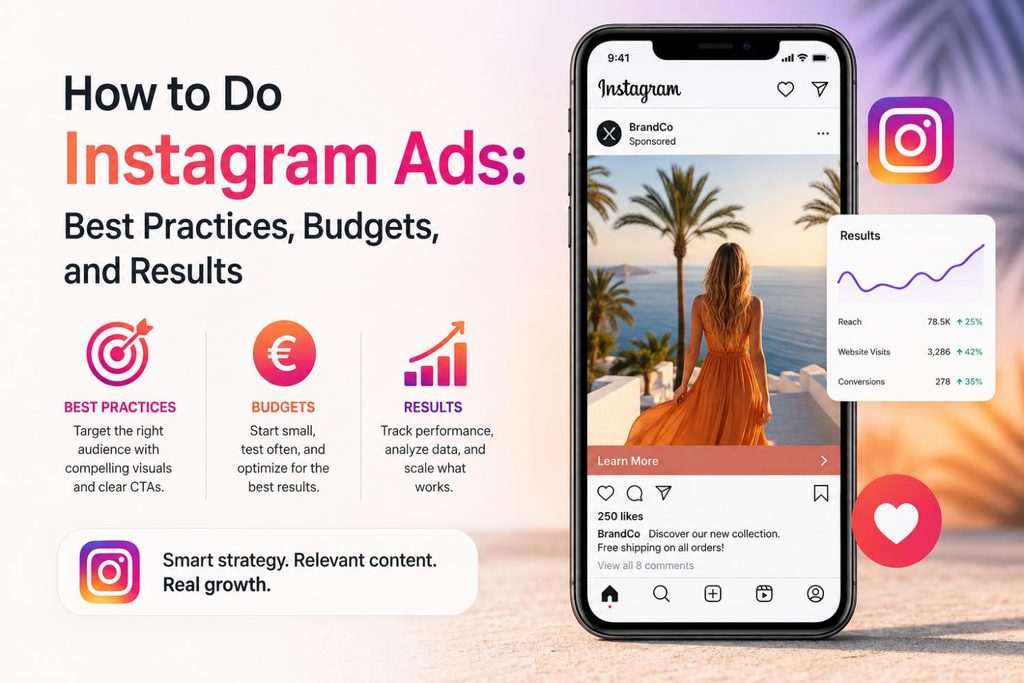
Why Advertise on Instagram in the First Place?
Before diving into the “how,” it’s worth understanding the “why.” Instagram ads run through Meta’s advertising system — the same infrastructure that powers Facebook ads — granting access to sophisticated audience-targeting and machine-learning systems.
Visual-First Format
Built around images, video, and Stories, making it a natural fit for brands with strong visual products like fashion, food, travel, home decor, beauty, and fitness.
High Engagement
Users tend to interact more with content on Instagram than on many other platforms, especially within high-visibility formats like Stories and Reels.
Younger & Engaged Audiences
Instagram over-indexes with users in their 20s and 30s, though its active user base has broadened significantly across broader demographics in recent years.
Seamless Shopping Features
Instagram Shopping, product tags, and “Shop Now” buttons let people transition from seeing an ad to completing a purchase in just a few taps.
Do I Need a Pixel to Run Instagram Ads?
This is one of the most common questions from beginners. The short answer is: you don’t strictly need one to run ads, but you almost certainly want one if you’re selling anything online.
It Lets You Measure Results
Without it, you can see how many people clicked your ad, but you have no idea what happened afterward. Did they buy something? Did they leave immediately? The Pixel closes that loop.
It Powers Smarter Targeting
Once the Pixel has enough data, Meta’s algorithm can build Lookalike Audiences — potential customers who share behavioral similarities with your existing buyers.
It Enables Retargeting
Have you ever seen an ad for an item follow you around for days? That’s Pixel-powered retargeting, one of the highest-converting formats because it targets expressed interest.
It’s Essential for Optimization
If you want Meta’s algorithm to find people likely to purchase rather than just click, it needs conversion data to learn from — and that data comes from the Pixel.
Is Instagram Advertising Difficult?
Here’s the honest answer: getting started is easy. Getting good at it takes practice. Meta Ads Manager has streamlined the setup process, but mastery lies beyond mere button-clicking.
The Mechanics Are Beginner-Friendly
Through Meta Ads Manager, you can choose objectives, define audiences, set budgets, upload creative, and launch a campaign in under 30 minutes with real-time feedback.
Everything Around the Button-Clicking
Real success comes from navigating the strategic elements that automation cannot solve for you — from creative stopping-power to avoiding common algorithmic traps.
Do Instagram Ads Actually Get Good Results?
The honest answer is: it depends heavily on your industry, product, creative quality, and how well you set up your targeting and tracking — but for a huge number of businesses, Instagram ads deliver strong, measurable results.
Product-Market Fit
Visually appealing, impulse-friendly, or problem-solving products perform best in a scroll-based visual environment, though B2B lead generation can also work with the right creative.
The Single Biggest Lever
Ads compete directly with organic content from friends and creators. Native, authentic, well-shot creative that engages in the first two seconds performs dramatically better.
Tracking & Optimization
Proper conversion tracking allows Meta’s algorithm to learn who converts, compounding results over time. Campaigns without tracking tend to plateau or optimize blindly.
Patience During Learning
Ad sets require roughly 50 conversion events in 7 days to exit the learning phase. Campaigns paused, edited, or judged too early rarely show their true potential.
Is It Worth It?
For most businesses with an online presence, yes — but “worth it” depends entirely on what you’re comparing it to and how your unit economics stack up.
Competitive Cost-Per-Click
Instagram often delivers lower cost-per-click rates than many alternative advertising platforms, especially for visually-driven products that capture immediate attention.
Granular Targeting & Retargeting
Leverage extremely detailed audience filters, custom segments, and pixel-based retargeting to reach users who have already expressed active interest.
Bypassing Organic Limits
Unlike declining organic reach, paid ads offer guaranteed visibility to a defined audience, on your timeline, and at scale across Stories, Reels, and feeds.
Robust ROAS Reporting
Strong performance data and tracking integrations give you clear visibility to calculate real return on ad spend and optimize profitability.
How to Set Up an Instagram Ad Campaign
Launching your first Instagram ad campaign requires a disciplined, step-by-step approach through Meta Ads Manager to ensure proper tracking and performance optimization.
Set Up Business Suite Account
Set up your Meta Business Suite / Business Manager account and connect your Instagram business profile.
Install the Meta Pixel
Install the Meta Pixel (and ideally the Conversions API) on your website before spending budget so every euro generates data from day one.
Define a Clear, Single Objective
Pick one objective (commonly traffic, engagement, or conversions) and build around it rather than trying to drive awareness, traffic, and sales all at once.
Prepare Creative Variations
Prepare 3-4 creative variations including different images, videos, or ad copy angles, as you cannot predict the winner until tested live.
Choose a Broad Starting Audience
Choose a reasonably broad starting audience because very narrow targeting often underperforms by starving the algorithm of learning data.
Set Testing Budget & Run Window
Set a testing budget and let it run for at least 5-7 days without major changes so the algorithm can cleanly exit the learning phase.
Review Results, Not Gut Feelings
Look at your cost per result, click-through rate, and ROAS. Kill what is underperforming and shift budget toward winning variations.
Iterate Constantly
Advertising is never “set and forget.” Constantly test new creative, refresh ad copy before fatigue sets in, and refine audiences based on performance data.
What’s the Ideal Budget to Start With?
There’s no universal magic number, but there are sensible guidelines for beginners looking to test campaigns without risking large amounts of capital before understanding what works.
Start Small, But Not Too Small
Begin with €10–€30 per day, per ad set, for at least a full week. This gives Meta’s algorithm enough signal to start learning without over-committing early capital.
Think in Conversions, Not Spend
Meta needs roughly 50 conversions within 7 days to properly optimize. Do the math backward based on your product price and expected conversion rate to gauge weekly capital needs.
Budget for Testing First
Set aside a testing pool to try 3–4 different audiences, creatives, or offers before committing serious spend to a single scaled campaign, avoiding untested single ideas.
Scale Incrementally
Once you find a high-performing combination, increase budget by 15–20% every few days. Sudden overnight budget doubling can reset algorithmic learning and hurt performance.
How Should I Start? A Step-by-Step Overview
If you’re launching your very first Instagram ad campaign, following a disciplined, sequential order of operations is essential for avoiding wasted ad spend.
Business Suite Setup
Set up your Meta Business Suite / Business Manager account and connect your Instagram business profile before launching any campaigns.
Install Meta Pixel & CAPI
Install the Meta Pixel and Conversions API on your website before spending budget so every euro generates actionable conversion data from day one.
Define a Single Objective
Don’t drive awareness, traffic, and sales all at once. Pick one core objective (traffic, engagement, or conversions) and build your campaign around it.
Prepare 3-4 Creative Variations
Build different images, videos, or copy angles. You genuinely cannot predict which creative variant will perform best until you test it live.
Choose a Broad Audience
Contrary to instinct, very narrow targeting often underperforms. A broader audience combined with strong creative gives the algorithm room to find buyers.
Run for 5-7 Days Unchanged
Set a testing budget and let it run for at least 5-7 days without major edits, allowing the algorithm to cleanly exit the learning phase.
Review Results, Not Gut Feelings
Look at cost-per-result, CTR, and ROAS. Kill what’s clearly underperforming and reallocate budget toward winning creative variations.
Iterate Constantly
Advertising is never “set and forget.” Top performers constantly test new creative, refresh ad copy before fatigue sets in, and refine audiences.
Who Is the Right Target Group?
In Instagram’s earlier days, advertisers relied on heavy manual targeting. Today, Meta’s algorithm has evolved so that broad targeting combined with strong signals (like Pixel data and Lookalike Audiences) often outperforms narrow manual parameters.
Start With What You Know
Look at your existing customers — their rough age range, gender split, geography, and interests. Build your initial baseline from real buyer behavior rather than guesswork.
Leverage Lookalike Audiences
Once your Pixel tracks a few hundred purchases or leads, create a Lookalike Audience. Meta will find new users behaving similarly to your best buyers — consistently a top performer.
Don’t Over-Narrow Too Early
Stacking multiple interest filters shrinks audience size to almost nothing, starving the algorithm of learning data. Start broad and let performance data guide you.
Isolate Retargeting Audiences
Website visitors and profile engagers need distinct, incentive-driven messaging. Run warm retargeting audiences in separate campaigns away from cold prospecting.
Test Demographic Assumptions
Many businesses discover through ad data that unexpected age brackets or genders convert better. Let actual conversion data challenge your assumptions instead of locking parameters based on instinct alone.
Final Thoughts
Instagram advertising sits in a unique sweet spot: accessible enough that anyone can launch a campaign within an hour, yet sophisticated enough to reward those who take the time to learn its mechanics properly.
Patience Over Perfection
The platform rewards testing, patience, and good creative far more than it rewards perfect targeting guesses or massive budgets.
Foundational Rules for Beginners
Install tracking first, start with a modest testing budget, prepare diverse creative variations, avoid over-narrowing, and give tests enough time to generate data.
Algorithmic Scale
When fed clean data and given room to learn, Meta’s algorithm consistently excels at finding the right people to turn ads into a scalable growth channel.
15 Most Frequent Questions About Instagram Ads
Everything you need to know about setting up campaigns, managing budgets, optimizing tracking, and scaling performance effectively.
01
Do I need a Pixel to run Instagram ads?
You don’t strictly need one to run basic ads, but you almost certainly want one if you’re selling online. The Meta Pixel and Conversions API track visitor actions, power Lookalike Audiences, enable retargeting, and provide crucial data for campaign optimization.
02
How much budget do I need to start?
A common recommendation is to begin with €10–€30 per day, per ad set, for at least a full week. For a comprehensive testing pool across multiple creative and audience variations, setting aside €200–€500 is ideal before scaling.
03
Is Instagram advertising difficult for beginners?
Getting started is easy and can take under 30 minutes via Meta Ads Manager. However, mastery lies in what happens around the button-clicking: writing scroll-stopping creative, aligning objectives, and avoiding premature edits during the learning phase.
04
Do Instagram ads actually get good results?
Yes, for a huge number of businesses they deliver strong, measurable results. Success depends heavily on product-market fit, creative quality, clean conversion tracking, and patience during the algorithmic learning phase.
05
How does the Meta learning phase work?
Every new or significantly edited ad set goes through a learning phase where Meta tests audiences to find optimal performance. This typically requires around 50 conversion events within a 7-day window to stabilize and exit the phase.
06
Should I target a broad audience or narrow interests?
Modern Meta advertising rewards broad targeting combined with strong signals (like Pixel data and Lookalike Audiences). Over-narrowing too early by stacking multiple interest filters starves the algorithm of enough people to learn from.
07
What are Lookalike Audiences and how do I use them?
Once your Pixel has tracked a few hundred purchases or leads, Meta can build a Lookalike Audience to find new users who share behavioral similarities with your existing best buyers. It is consistently one of the best-performing targeting tools available.
08
How important is creative quality on Instagram?
It is arguably the single biggest lever. Your ad competes directly with organic content from friends and creators. Native, authentic, well-shot creative that engages users in the first two seconds performs dramatically better than stock imagery.
09
Should I run retargeting campaigns separately?
Yes. Website visitors and Instagram profile engagers are warm audiences who require distinct, incentive-driven messaging (like reminders or discounts) rather than a cold introduction. Run them in separate campaigns away from prospecting.
10
How do I scale my budget without ruining performance?
Once you find a high-performing combination, increase your budget incrementally by 15–20% every few days rather than doubling it overnight. Sudden large budget jumps can reset algorithmic learning and temporarily hurt performance.
11
What campaign objective should I pick?
Pick a single, clear objective for your first campaign (commonly traffic, engagement, or conversions) based on your core business goal. Avoid trying to drive awareness, traffic, and sales all at once within a single ad set.
12
How many creative variations should I test at once?
Preparing 3 to 4 creative variations (different images, videos, or copy angles) is ideal. You genuinely cannot predict which variant will perform best until tested live against real audience behavior.
13
How long should I let an ad run before making changes?
Let your ad set run for at least 5 to 7 days without major edits. Campaigns that get paused, edited, or judged too early based on gut feelings rather than data rarely show their true potential.
14
What metrics matter most when reviewing performance?
Look at your cost per result, click-through rate (CTR), and return on ad spend (ROAS) if tracked. Kill what is clearly underperforming and reallocate budget toward winning creative variations.
15
Are Instagram ads better than organic social media?
They serve different purposes, but paid ads offer something organic reach increasingly cannot: guaranteed visibility to a defined audience, on your timeline, and at scale, bypassing declining organic algorithm visibility.