
How to Build Domain Authority
Domain Rating and SEO Trust
If you’ve spent any time in SEO forums or tools like Ahrefs and Moz, you’ve run into the term “domain authority” or “domain rating” more times than you can count. It gets thrown around as if it’s a single lever you can pull — get your number up, and rankings follow. The reality is messier and more interesting.
Authority isn’t a metric you chase directly; it’s a byproduct of decisions you make about links, content, technical health, and time. This article breaks down what authority actually is, why it matters, and — more usefully — the concrete, repeatable steps that move it in the right direction.
What “Authority” Actually Means
Before going further, it is worth separating two things people often conflate: third-party scores like Domain Rating and Domain Authority versus actual search engine trust.
Third-Party Metrics (DR & DA)
Domain Rating (from Ahrefs) and Domain Authority (from Moz) are proprietary scores built primarily from backlinking data rather than being used as ranking factors by Google.
Actual Search Engine Trust
Google’s internal assessment is built from link quality, content depth, originality, user behavior, technical health, topical consistency, and entity recognition.
Avoiding DR-Chasing
While buying links or link farming can nudge a third-party score, very little of it builds the kind of algorithm-resilient trust that protects long-term traffic.
Why Authority Compounds
Authority behaves like compound interest rather than a one-time achievement, meaning a new site with zero history has to work far harder to rank than a mature site with a track record.
Compound Behavior Over Time
Authority acts like compound interest; a new site with zero backlinks and history must work harder to rank than a five-year-old site with a track record.
The “Sandbox Effect”
While Google hasn’t officially confirmed its mechanics, the pattern of the sandbox effect is consistent enough that experienced SEOs plan around it.
Long-Term Commitment
Authority building requires a multi-quarter or multi-year commitment, asking whether a tactic remains a credible signal in two years rather than chasing monthly metrics.
The Core Pillars of Website Authority
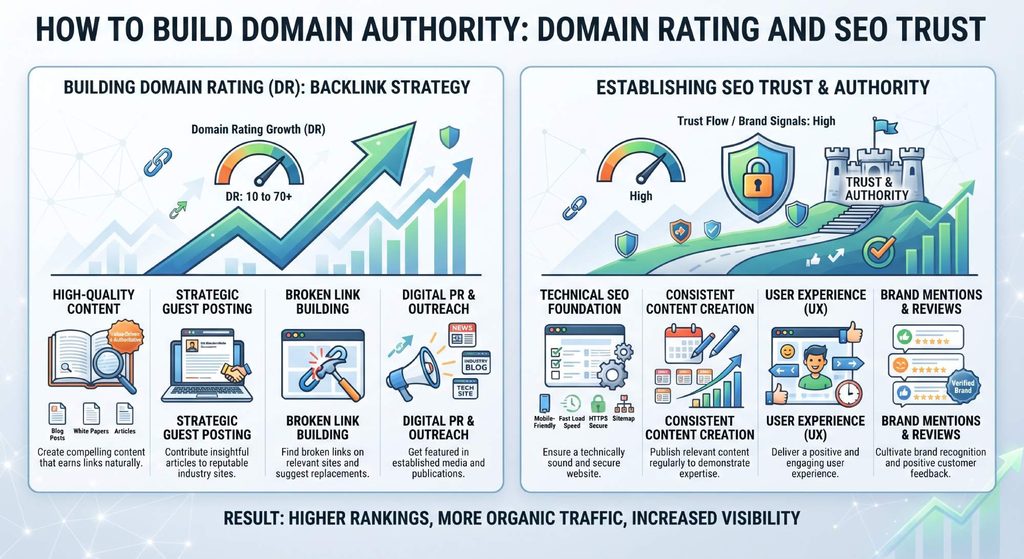
Building genuine, algorithm-resilient authority requires mastering backlinks, content depth, technical health, consistency, and comprehensive E-E-A-T signals.
1. Backlinks & Relevance
Backlinks remain fundamental through link graphs, prioritizing domain relevance, editorial context, diversity, and natural anchor text profiles over sheer volume.
2. Content Depth & Clusters
Google evaluates site-level topical authority, making comprehensive topic clusters and interlinked subtopic pages outperform scattered, isolated articles.
3. Technical Health & E-E-A-T
Technical hygiene, crawlability, mobile usability, and strong E-E-A-T signals (experience, expertise, authoritativeness, trustworthiness) ensure search engines extend full trust.
Core Pillars of Website Authority Matrix
| Pillar | Key Factor | Strategic Execution Focus |
|---|---|---|
| Backlinks | Quality & Context | Focus on editorial context, diverse referring domains, digital PR, and skyscraper outreach instead of link buying. |
| Topical Depth | Content Clusters | Map out subtopic clusters and interlink pillar pages to build comprehensive resource signals. |
| Technical Health | Crawlability & Speed | Maintain strict Core Web Vitals, indexation health, secure HTTPS, and clean internal linking structures. |
| Consistency | Sustained Output | Treat the first 6 to 12 months as an investment period prioritizing steady, predictable publishing patterns. |
| E-E-A-T | Trust Signals | Incorporate clear author bios, transparent contact pages, first-hand experience, and credible sourcing. |
A Practical 90-Day Starting Plan
For anyone building authority from scratch or trying to recover a stagnant site, here’s a sequenced approach rather than a scattered task list.
Weeks 1–2: Technical Audit
Fix crawl errors, confirm indexation, check Core Web Vitals, and clean up any obvious duplicate or thin content.
Weeks 3–6: Content Gap Mapping
Identify core topic clusters, audit existing content, and prioritize the 5 to 10 pieces of content that will close the biggest gaps.
Weeks 4–12: Linking & Outreach
Strengthen internal links between related pieces, start with unlinked mention recovery and broken link building, and lock in a sustainable publishing cadence.
90-Day Authority Action Plan Matrix
| Timeline | Phase Focus | Action Items |
|---|---|---|
| Weeks 1–2 | Technical Audit | Fix crawl errors, confirm indexation, check Core Web Vitals, and prune duplicate or thin pages. |
| Weeks 3–6 | Content Gap Mapping | Identify core topic clusters and prioritize 5–10 pieces to close content gaps. |
| Weeks 4–8 | Internal Linking Pass | Strengthen internal links between related pieces for fast, measurable movement. |
| Weeks 6–12 | Outreach & Digital PR | Execute unlinked mention recovery and broken link building before data-driven PR pushes. |
| From Week 8 | Publishing Cadence | Lock in a sustainable publishing schedule (e.g., one solid article every two weeks) past the 90-day mark. |
What to Avoid
A few risky tactics still get recommended despite carrying severe penalties; avoiding them is essential to protecting your search engine trust and long-term authority.
PBNs & Paid Link Schemes
Private blog networks and paid link schemes violate Google’s guidelines directly and, when caught, can trigger manual actions that are difficult to recover from.
Reciprocal Links & Content Spinning
Systematic link swapping at scale creates a detectable pattern, while content spinning or unreviewed AI content dilutes topical authority and triggers suppression systems.
Chasing DR/DA Directly
Optimizing for a third-party metric instead of the underlying signals it attempts to approximate is optimizing for the map instead of the territory.
How to Get More Authority with a Domain with No Backlinks
A new site with zero backlinks and no history has to work harder to rank for competitive terms, requiring a strategic approach to build compound search engine trust.
Topical Depth & Clusters
Build comprehensive content clusters and interlinked subtopic pages to signal genuine expertise and resource value rather than relying on isolated pages.
Technical Hygiene & Audits
Fix crawl errors, confirm indexation, and optimize Core Web Vitals to ensure search engines can properly parse your site structure from day one.
Compound Investment Period
Treat the first 6 to 12 months as an investment period focused on steady publishing cadence and long-term signal credibility rather than fast wins.
Zero-Backlink Authority Strategy Matrix
| Phase | Core Focus | Actionable Execution |
|---|---|---|
| Weeks 1–2 | Technical Hygiene | Resolve crawl errors, confirm indexation, and clean up duplicate content. |
| Weeks 3–6 | Content Gap Mapping | Establish core topic clusters and build foundational explainer content. |
| Weeks 4–8 | Internal Linking Pass | Strengthen internal link structures to distribute authority evenly across new pages. |
| Ongoing | Sustained Publishing | Commit to a realistic, regular publishing schedule that allows authority to compound over quarters and years. |
Healthy Ways to Build Backlinks: Paid, Free, or Viral?
Backlinks remain fundamental through core link graphs, but building them healthily requires focusing on quality, editorial context, and natural link profiles rather than risky shortcuts.
The Danger of Paid Links
Paid link schemes and private blog networks (PBNs) violate Google guidelines directly and trigger manual actions that are difficult to recover from.
Free & Organic Methods
Earn links freely through digital PR, original data, skyscraper content creation, unlinked mention recovery, and broken link building.
Quality Over Quantity
Prioritize relevance, editorial context, and referring domain diversity over sheer link counts or risky reciprocal link swapping.
Backlink Strategy Evaluation Matrix
| Approach | Method Type | Risk Level & Strategic Value |
|---|---|---|
| Paid / PBNs | Paid Link Schemes | High Risk: Violates guidelines and triggers severe manual actions. |
| Reciprocal Swapping | Systematic Exchanges | Medium Risk: Scaling link swaps creates a detectable pattern. |
| Digital PR & Research | Free / Earned | Low Risk / High Value: Publishing original surveys and data attracts natural citations. |
| Skyscraper Outreach | Free / Content-Led | Low Risk / High Value: Building superior content and reaching out to sites linking to weaker versions. |
The Bottom Line
Website authority isn’t a switch you flip; it’s the accumulated result of publishing consistently useful content, earning organic links, maintaining technical foundations, and letting authority compound over time.
Accumulated Results
Authority accumulates by publishing useful content consistently, earning citations because others find you worth linking to, and keeping technical foundations clean.
Unglamorous Fundamentals
Dominant sites win not through single clever tricks, but by executing content depth, link earning, and technical hygiene more consistently than competitors.
Patience and Measurement
Track referring domains, topical coverage, and technical health monthly, letting third-party metrics serve as lagging indicators rather than direct targets.