
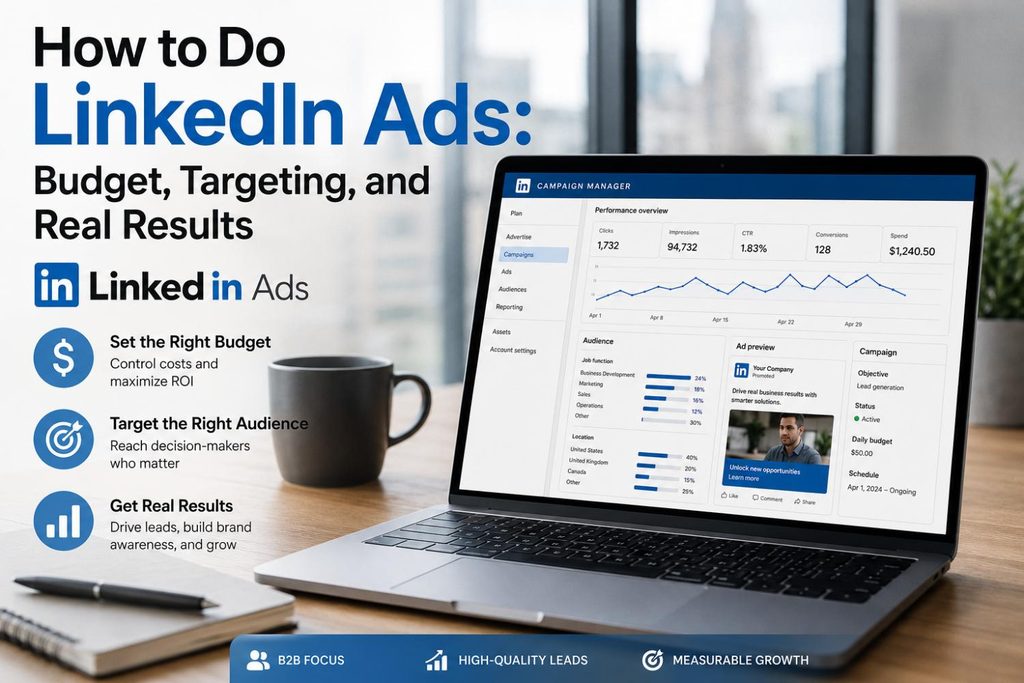
How to Do LinkedIn Ads:
Budget, Targeting, and Real Results
LinkedIn is built entirely around professional identity. Instead of guessing based on behavior, you target exact job titles, industries, seniorities, and company names.
💼 Master precision B2B marketing without wasting budget: learn best practices, tracking setup, realistic benchmarks, and scaling frameworks. 🚀✨
Why LinkedIn Ads Are Different
Before diving into tactics, it helps to understand what LinkedIn is actually good at.
Where LinkedIn Ads Shine
LinkedIn Ads excel in B2B (business-to-business) contexts, especially when selling offerings with longer sales cycles, higher price tags, or niche audiences. Think software companies targeting IT directors, consultancies targeting HR leaders, or agencies pitching marketing managers with unmatched professional targeting accuracy.
Where LinkedIn Is Not Ideal
LinkedIn is less effective for low-cost consumer products, impulse purchases, or campaigns requiring cheap, high-volume traffic. If you’re selling sneakers or driving gaming app downloads, platforms like Meta or TikTok will yield far better results.
Best Practices for LinkedIn Ads
Maximize your B2B campaign efficiency with these seven proven optimization principles designed to drive qualified leads and prevent wasted ad spend.
Start with a Clear Objective
Campaign Manager organizes objectives into Awareness, Consideration, and Conversion. Choosing the wrong objective (e.g., picking “Awareness” when you want form fills) optimizes your budget toward impressions rather than leads.
Use Native Lead Gen Forms
LinkedIn’s Lead Gen Forms auto-populate profile data to remove friction entirely, yielding much higher conversion rates than external landing pages for demo requests or whitepaper downloads.
Segment Your Audience
Unlike Meta, broad targeting on LinkedIn leads to premium prices for poor fits. Build tightly defined segments (e.g., VP-level, Marketing, Software) and tailor creative to each group.
Match Creative to Funnel Stage
Cold audiences need low-commitment educational content, while warm audiences are ready for demos and case studies. Running demo ads to cold traffic burns budget with no return.
Test Diverse Creative Formats
Leverage single images, carousels, video ads, text ads, and Message Ads. Video drives efficiency, carousels excel at storytelling, and Message Ads deliver high-value offers when kept personal.
Write for Scanners, Not Readers
Lead with benefits in the first line, keep sentences short, and use specific calls to action. A single clear message consistently outperforms ads trying to say five things at once.
07. Don’t “Set and Forget”
LinkedIn campaigns require active management because audience saturation and ad fatigue move faster due to smaller audience sizes. Check performance weekly, refresh creative every few weeks, and pause underperforming segments quickly.
Do I Need a Pixel?
Yes — almost always, yes. The LinkedIn Insight Tag is a small JavaScript snippet that powers your core tracking capabilities.
Conversion Tracking
It tells LinkedIn when someone who clicked your ad completed a valuable action (form submission, purchase, sign-up). Without this, you’re optimizing blind — tracking click volume without knowing conversions.
Retargeting (Matched Audiences)
Build custom audiences of past website visitors to run direct, warm-up campaigns. Retargeting audiences on LinkedIn typically convert far better than cold traffic since prospects already know your brand.
Website Demographics Reporting
Even before running ads, the Insight Tag shows job titles, industries, and company sizes of organic visitors — providing crucial data for planning your first campaign’s targeting.
Straightforward Installation
LinkedIn generates a snippet in Campaign Manager under Account Assets > Insight Tag, which you either paste into your site’s header or install via Google Tag Manager. If you’re running conversion or retargeting campaigns — which most B2B advertisers are — skipping the Insight Tag means flying without instruments.
How We Handle Good LinkedIn Campaigns
Running LinkedIn Ads well isn’t about setting a budget and hoping for the best. Explore our structured five-step approach.
Mapping the Buyer First
Before building a single ad, we map out job titles, seniority, industries, company size, and specific Account-Based Marketing targets. LinkedIn’s targeting is only as good as the thinking behind it.
Funnel-Based Segmentation
Campaigns are split by funnel stage: Top-of-funnel (educational content), Middle-of-funnel (case studies, comparisons), and Bottom-of-funnel (demo requests, free trials for warm audiences).
Parallel Testing
At least 3–4 ad variations run simultaneously with different headlines, formats, or offers. Parallel testing gets you to a winning combination faster than sequential testing.
Weekly Optimization Cycles
Underperforming ads get paused weekly, budgets shift toward what works, and new creative variants get introduced. Frequency is watched closely to prevent ad fatigue.
05. Conversion Tracking Tied to Real Business Outcomes
Clicks and form fills matter, but the real measurement is how many leads become qualified opportunities and customers, often requiring connecting LinkedIn data with a CRM.
Are There Good Results?
Genuinely — yes, but the definition of “good” looks different than on other platforms.
CTR: 0.4% to 0.65%
Standard image or video ads typically range between 0.4% and 0.65%, sometimes higher for well-targeted Message Ads. While noticeably lower than Meta or Google, comparing raw CTR across platforms is misleading — audience quality is the entire point.
CPC: €5 to €15
CPC usually falls between €5 and €15, depending on industry, competition, and audience definition. Highly competitive sectors like software or financial services often sit at the higher end.
CPL: €30 to €150+
Using Lead Gen Forms, CPL commonly ranges from €30 to over €150. While this sounds expensive compared to Facebook, a single closed B2B deal can be worth many times the ad spend that generated it.
What Produces Good Results
- Tightly defined audiences: Prioritizing specific segmentation over broad targeting.
- Lead Gen Forms: Utilizing native forms over external landing pages for lead volume.
- Retargeting: Engaging past website visitors who convert at significantly higher rates.
- Rich media: Leveraging video and carousel content over static images for awareness.
What Produces Disappointing Results
- Broad targeting with generic messaging: Failing to tailor creative to professional segments.
- Cold traffic to demo requests: Asking for high commitment too early in the cycle.
- Under-budgeting: Starving the algorithm of the data it needs to optimize effectively.
- Treating LinkedIn like direct-response: Expecting immediate consumer purchases instead of long-cycle B2B conversions.
Is It Worth It?
This depends almost entirely on what you’re selling and to whom.
LinkedIn Ads Are Worth It If:
- Meaningful deal size: Single customers are worth at least a few hundred euros, ideally more.
- Identifiable profiles: Your buyer has an identifiable job title, industry, or company profile.
- Absorbable sales cycle: You can absorb a “nurture” period rather than needing instant conversions.
- Revenue tracking: You track leads through to actual revenue to judge ROI properly rather than counting cheap clicks.
LinkedIn Ads Are Probably Not Worth It If:
- Consumer products: You’re selling a low-cost consumer product.
- Small budget: Your budget is very small and can’t sustain higher CPCs long enough to gather data.
- Non-professional traits: Your target audience relies on age or personal interest rather than job title.
The ROI Case for Qualifying B2B Businesses
The ROI case is strong specifically because the targeting precision reduces wasted spend on people who could never become customers — even though each click costs more, the clicks are more likely to matter.
Ideal Budget
There’s no single “right” number, but here’s a practical framework to guide your LinkedIn Ads investment.
€1,500–€3,000 / mo
Minimum viable testing budget. Below this, LinkedIn’s algorithm struggles to gather enough data to optimize delivery, and you won’t get a reliable read on what’s working versus what’s noise.
€3,000–€10,000 / mo
Solid mid-range budget where most growing B2B companies land — enough to run a proper funnel structure (top, middle, bottom) with real creative testing at each stage.
€10,000+ / mo
Typically deployed once you’ve identified winning audience segments and creative, allowing you to expand into new segments, industries, or geographies.
Daily Budget Rule of Thumb
Your daily budget should be high enough to get roughly 15–25 clicks per day per campaign so you accumulate statistically meaningful data within a few weeks. Given typical CPCs, that often means €50–€100 per day per active campaign.
Budgeting Time, Not Just Money
Expect the first 2–4 weeks of any new LinkedIn campaign to be a “learning phase” where performance is less predictable — this is normal and not a sign of failure. 🚀
How Should I Start?
If you’re setting up LinkedIn Ads for the first time, follow this sensible order of operations to ensure strong technical setup and campaign efficiency.
Set Up Your LinkedIn Company Page
Ensure you have a well-maintained company page since your ads will link back to it, as a thin or outdated page hurts your professional credibility.
Install the Insight Tag
Ensure tracking is live on your website before spending a single euro on ads to capture critical conversion and visitor data.
Define Your ICP Clearly
Map job titles, seniority, industries, and company sizes. Specificity like “Marketing Managers at B2B SaaS companies” beats broad “marketers.”
Pick One Clear Objective
Resist the urge to run five campaigns with five goals at once. Start with a single objective, learn from performance, and then expand.
Build 3–4 Ad Variations
Include different headlines or hooks at minimum so you aren’t relying on a single creative to prove or disprove the whole channel.
Set a Realistic Starting Budget
Commit to running your initial budget framework for at least 3–4 weeks before drawing firm conclusions about channel ROI.
Review Weekly, Not Daily
Daily fluctuations on LinkedIn are common and can lead to premature, wrong decisions if you react too quickly to short-term data.
Layer in Retargeting
Introduce retargeting campaigns once you have website traffic flowing from your initial setup — this is where real efficiency gains appear.
Which Is the Target Group?
This is really the heart of any LinkedIn campaign, because targeting precision is the platform’s core advantage. LinkedIn lets you combine multiple targeting dimensions.
Job Title & Function
Target specific seniority levels such as “Director”-level or above within functional areas like “Marketing”.
Industry
Focus campaigns on vertical sectors like Software, Financial Services, and Healthcare.
Company Size
Filter organizations ranging from small seed-stage startups to massive enterprise structures.
Company Name
Essential for Account-Based Marketing when executing campaigns against curated target lists.
Skills & Interests
Target users based on professional skills listed on profiles or active topical engagement.
Years of Experience
Isolate career experience thresholds to match decision-maker maturity levels.
Education
Filter by academic institutions, specific fields of study, and earned degrees.
Professional Groups
Reach specialized professionals belonging to specific LinkedIn community groups.
Matched Audiences
Leverage uploaded contact lists, website visitors via the Insight Tag, or lookalike models.
Combining Dimensions for Precision
The most effective approach combines two or three dimensions. “Marketing function + Director seniority + Software industry + 200–1000 employees” reaches the right people without over-narrowing delivery.
Define Your ICP First
Build your ICP definition before opening Campaign Manager based on your actual best customers today — targeting is only as good as the clarity of the profile you feed into it. 🚀
Final Thoughts
LinkedIn Ads reward precision, patience, and a willingness to treat B2B advertising differently than consumer advertising.
Why the Premium Is Worth It
The clicks cost more, but they come from an audience defined by professional identity rather than guesswork — which, for the right business, is exactly what makes the platform worth the premium.
From Experiment to Reliable Channel
Install the Insight Tag early, define your audience tightly, structure campaigns around the funnel rather than a single generic push, and give the platform enough budget and time to learn.
LinkedIn Ads: 15 Essential Questions Answered
Explore frequently asked questions about LinkedIn Ads strategy, Insight Tag tracking, budget frameworks, professional targeting precision, and B2B campaign execution.
01 What contexts are LinkedIn Ads actually good at?
LinkedIn Ads shine in B2B contexts, especially when selling offerings with longer sales cycles, higher price tags, or niche audiences like software for IT directors or consulting for HR leaders.
02 Where is LinkedIn not ideal for advertising?
LinkedIn is poorly suited for low-cost consumer products, impulse purchases, or campaigns needing cheap, high-volume traffic like sneakers or gaming app downloads.
03 What are the best practices for structuring LinkedIn campaigns?
Start with clear objectives, use native Lead Gen Forms, segment tightly instead of going broad, match creative to funnel stages, test multiple formats, write for scanners, and avoid setting and forgetting.
04 Do you need a pixel for LinkedIn Ads?
Yes, almost always. The LinkedIn Insight Tag handles conversion tracking, retargeting via Matched Audiences, and website demographics reporting for planning campaign targeting.
05 How should you handle good LinkedIn campaigns?
Prioritize upfront audience research, use funnel-based campaign structures, test 3–4 creative variations in parallel, run weekly optimization cycles, and tie conversion tracking directly to CRM revenue outcomes.
06 What kind of results and CTRs can you expect on LinkedIn?
Click-through rates (CTR) typically range from 0.4% to 0.65% for standard image or video ads. While lower than Meta or Google, audience quality is significantly higher.
07 What are typical CPC and CPL benchmarks on LinkedIn?
Cost-per-click (CPC) usually falls between €5 and €15 depending on industry competition. Cost-per-lead (CPL) via Lead Gen Forms commonly ranges from €30 to over €150.
08 What practices produce good results versus disappointing ones?
Tight audience segmentation, native Lead Gen Forms, and retargeting yield great results, whereas broad targeting with generic messaging, under-budgeting, and treating LinkedIn like a direct-response platform lead to failure.
09 Are LinkedIn Ads worth it for your business?
They are worth it if you sell B2B products with meaningful deal sizes, identifiable professional buyer profiles, and sales cycles that can absorb nurture periods with proper revenue tracking.
10 What is the ideal monthly budget framework?
A minimum viable testing budget is €1,500–€3,000 per month, solid mid-range budgets sit between €3,000–€10,000, and scaling budgets exceed €10,000 monthly for multi-segment expansion.
11 How should you calculate daily campaign budgets?
Aim for a daily budget high enough to accumulate 15–25 clicks per day per campaign (roughly €50–€100 per day) to gather statistically meaningful data within a few weeks rather than months.
12 What is the correct order of operations to start?
Set up a professional Company Page, install the Insight Tag, define your Ideal Customer Profile (ICP), pick one clear objective, build 3–4 ad variations, and review weekly rather than daily.
13 What targeting dimensions can you combine on LinkedIn?
You can combine job titles, job functions, seniority, industries, company sizes, company names (ABM), skills, years of experience, education, groups, and Matched Audiences.
14 Why is combining multiple targeting layers important?
Relying on a single dimension like “Marketing” is too broad. Combining function, seniority, industry, and company size targets exact decision-makers without over-narrowing delivery.
15 What are the final takeaways for mastering LinkedIn Ads?
LinkedIn Ads reward precision, patience, and professional identity. Treating B2B advertising with structured funnels turns it into a highly reliable channel for reaching crucial decision-makers.