
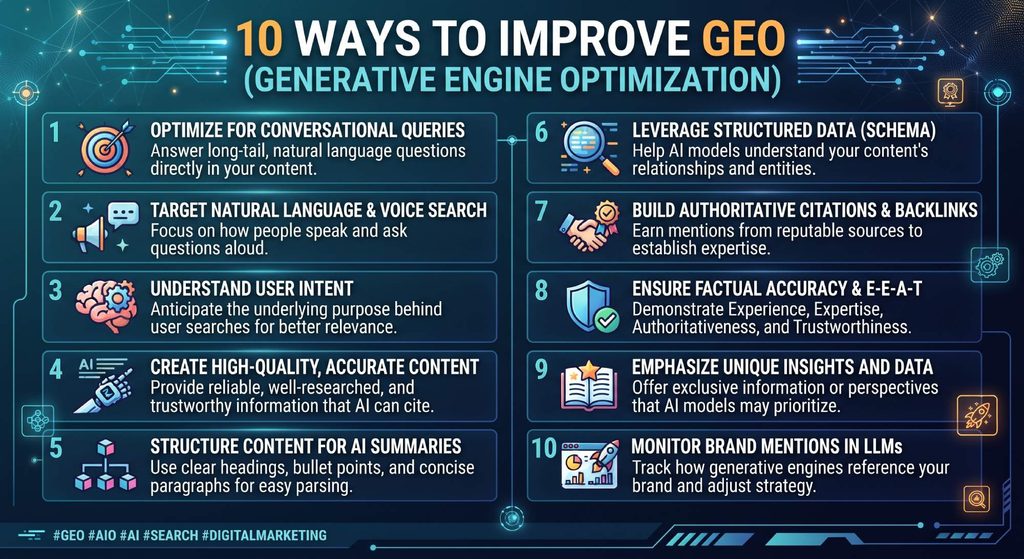
10 Ways to Improve GEO
(Generative Engine Optimization)
Search behavior has changed faster in the last two years than in the previous two decades. People no longer just type a query into Google and scroll through ten blue links — they ask ChatGPT, Perplexity, Claude, or Google’s AI Overviews a question and expect a synthesized answer, often with sources cited inline. This shift has given rise to a new discipline sitting alongside traditional SEO: GEO, or Generative Engine Optimization.
The problem is that most advice on GEO right now is either vague (“just write helpful content!”) or purely theoretical, with no clear path from idea to implementation. This article is different. Below are ten concrete, practical ways to improve your GEO performance — things you can actually do this week, not abstract principles to nod along to.
Restructure Content Around Direct-Answer Blocks
Generative engines retrieve chunks of text that answer specific queries with minimal ambiguity, meaning buried key facts risk being replaced by a competitor’s cleaner version.
How Engines Read
Unlike humans scrolling from top to bottom absorbing narrative flow, AI models retrieve isolated chunks of text—often a paragraph or a few sentences—matching specific queries.
The Practical Fix
Include a tight, self-contained block of 40 to 80 words for every important question, front-loading clarity by stating answers plainly without requiring prior paragraphs.
The GEO Test
If you copy a single paragraph into a blank document and it makes complete sense answering the question fully without relying on “as mentioned above,” it is GEO-friendly.
Use Explicit Question-and-Answer Formatting
Generative engines are trained on enormous volumes of Q&A-structured content and prioritize that pattern when matching user questions to sources.
Training Patterns
AI models learn to recognize and prioritize Q&A structures from forums, FAQs, and documentation, pulling content that mirrors this format more reliably than implied prose.
Practical Implementation
Add FAQ sections to key pages, phrase subheadings as actual questions users would type or speak, and answer each one directly in the very first sentence that follows.
Real Customer Phrasing
Mine support logs and sales call notes for actual phrasing people use, building Q&A sections around real questions rather than assumptions.
Strengthen Structured Data and Schema Markup
While structured data has long been an SEO best practice for rich snippets, its role has expanded under GEO as a high-confidence signal for generative engines.
High-Confidence Signals
Crawlers and generative engines use JSON-LD structured data as a high-confidence signal to understand what a page is about, who wrote it, and when it was published.
Targeted Schema Types
Implement Article, FAQPage, HowTo, and Organization schema with accurate author fields and sameAs references to verified profiles to establish topical authority.
Removing Ambiguity
Schema doesn’t guarantee citation, but it removes ambiguity, allowing generative systems to reward well-labeled content over content requiring inferred structure.
Publish Original Data, Statistics, and Research
One of the most consistent patterns in what generative engines choose to cite is originality of information, moving away from secondhand statistics toward primary sources.
The Power of Originality
When multiple articles restate the same secondhand statistic, engines tend to converge on citing whichever source is treated as the most original and authoritative.
Creating New to Cite
Publishing survey results, internal benchmarks, or case study figures gives generative engines something genuinely new to cite rather than paraphrasing interchangeable sources.
Transparent Methodology
Frame internal data clearly with methodology details like sample size and timeframe, since engines and human fact-checkers weigh credibility based on transparency.
Write for Extractability, Not Just Readability
Traditional writing optimizes for narrative flow and suspense, whereas generative engines prioritize locating clear, complete, correctly-scoped statements of fact.
Flow vs. Extraction
Traditional writing uses varied sentence length and delayed payoffs for suspense, but generative engines ignore suspense in favor of clear, complete statements of fact.
Practical Discipline
Add a second layer of discipline by stating conclusions before justifications (inverted-pyramid style), avoiding pronoun ambiguity, and using consistent terminology.
The Extraction Test
Read your draft as if you were a system trying to pull out three standalone facts; if you struggle to find clean, unambiguous statements, retrieval systems will too.
Build and Maintain Topical Depth, Not Just Volume
Generative engines weigh topical authority heavily, favoring sites with comprehensive, consistent expertise across a subject area rather than isolated articles surrounded by unrelated content.
Topical Authority Weighting
Generative engines and search algorithms look for consistent expertise across a subject area, making a single strong article within an unrelated site far less authoritative than part of a cluster.
Auditing by Topic Cluster
Audit content by topic cluster rather than individual page performance, ensuring core subject areas feature foundational explainers, advanced guides, and trend data.
Strategic Internal Linking
Reinforce topical relationships for both crawlers and retrieval mechanisms by using descriptive, question-relevant anchor text instead of generic links.
Get Cited and Mentioned Across the Web, Not Just Linked
While traditional SEO treats backlinks as the primary off-page authority signal, GEO research points to brand and entity mentions across the web functioning as trust signals for generative engines.
The Power of Unlinked Mentions
Brand and entity mentions across the web — even unlinked ones — function as trust signals because generative systems are trained on a much wider corpus than hyperlinked citation graphs.
Credibility Independent of Links
PR, guest contributions, podcast appearances, and community participation on platforms like Reddit or forums feed into how a generative engine perceives your credibility independently of clickable links.
Broadening Outreach & Consistency
Broaden digital PR beyond link-building by pitching as a journalist source and contributing useful answers consistently, since inconsistent name spelling dilutes the entity signal.
Keep Content Demonstrably Current
Generative engines are sensitive to recency for topics where facts change, making outdated articles weaker citation candidates compared to recently updated competitor pieces.
Sensitivity to Recency
For topics like pricing, statistics, and regulatory info where facts change, an article that hasn’t been updated in years becomes a weaker citation candidate.
Treating Content as a Living Asset
Set a recurring review cadence and make updates visible through revised schema markup, “last updated” notes, and brief changelogs for substantial revisions.
Substantive vs. Cosmetic Updates
Refreshing data points provides a legitimate reason to signal freshness rather than cosmetically changing dates without substantive revisions, which systems easily detect.
Make Author Expertise Explicit and Verifiable
Generative engines weighing which sources to trust increasingly factor in signals of genuine author credibility rather than relying solely on domain authority.
Beyond Domain Authority
Real names, credentials, and checkable track records outperform anonymous or generic bylines as AI systems assess trustworthiness for source citations.
Practical Implementation
Ensure every substantive piece has a named author with a genuine bio linked to a consistent author page, connecting identities to external verifications like LinkedIn or certifications.
Higher-Stakes Topics
Explicit author expertise matters even more in high-stakes categories like health, finance, and legal, though it remains a vital trust signal across the board.
Monitor How Generative Engines Are Already Citing (or Ignoring) You
You can’t optimize what you don’t measure, and while GEO measurement is still maturing, the practical starting point is directly querying major generative engines with real target questions.
Direct Querying
Query generative engines using the real questions your target audience would ask to record whether and how your content shows up.
Recurring Checks & Logging
Take your top 15 to 20 target questions, run them through ChatGPT, Perplexity, Google’s AI Overviews, and Claude, and log brand appearances, link citations, and competitor sources.
Emerging Tracking Tools
While growing GEO-specific monitoring tools automate tracking, a manual monthly spreadsheet surfaces actionable patterns faster than waiting for analytics ecosystems to mature.
Bringing It Together
None of these ten practices work in total isolation; they reinforce each other when combined within topically deep, schema-marked, regularly updated pages written by verifiable authors.
Reinforcing Practices
Direct-answer blocks are more likely to get cited when they sit within a topically deep, schema-marked page accumulating genuine web mentions.
Good Content Execution
GEO isn’t a separate discipline bolted onto content strategy, but rather good content execution keeping retrieval and extraction in mind.
Succeeding in AI Search
Winning brands treat clarity, originality, structure, and demonstrable expertise as first-class priorities early on.
10 Most Frequent Questions & Answers on How to Improve GEO
Direct, actionable answers to the top questions about optimizing your content for generative engines, structuring schemas, and increasing AI citations.
1. What Is GEO?
Generative Engine Optimization increases the likelihood that AI-generated answers reference or cite your content when responding to user queries.
2. Does GEO Replace SEO?
No. GEO is an additional layer built on top of traditional SEO fundamentals, because many generative engines rely heavily on existing search indexes.
3. How Do I Rank Faster?
Audit crawler access, sharpen your highest-authority pages, and move direct, extractable answers straight to the top of your sections.
Top 10 GEO Questions & Answers Matrix
| # | Frequently Asked Question | Direct Answer & Improvement Strategy |
|---|---|---|
| 4 | How do I use direct-answer blocks? | Include a self-contained block of 40 to 80 words for every major question, front-loading clarity so models can extract answers without ambiguity. |
| 5 | Why use explicit Q&A formatting? | Generative engines are trained on massive volumes of Q&A content; phrasing subheadings as real questions prioritizes your content for matching. |
| 6 | How does schema markup help? | Implementing FAQPage, Article, and HowTo schema provides high-confidence signals for crawlers, removing structural ambiguity. |
| 7 | What role does original data play? | Publishing primary surveys and internal benchmarks gives engines something genuinely new to cite rather than recycling secondhand statistics. |
| 8 | How do I write for extractability? | Use inverted-pyramid style, avoid pronoun ambiguity, and maintain consistent terminology across paragraphs. |
| 9 | Why is topical depth important? | AI engines weigh holistic expertise heavily; well-linked clusters of related content outperform isolated strong articles. |
| 10 | How do I monitor performance? | Set up recurring checks by querying major AI engines with target questions and logging brand citations in a monthly tracking spreadsheet. |