
Topical Authority vs. Keyword Stuffing:
Winning Spanish SEO
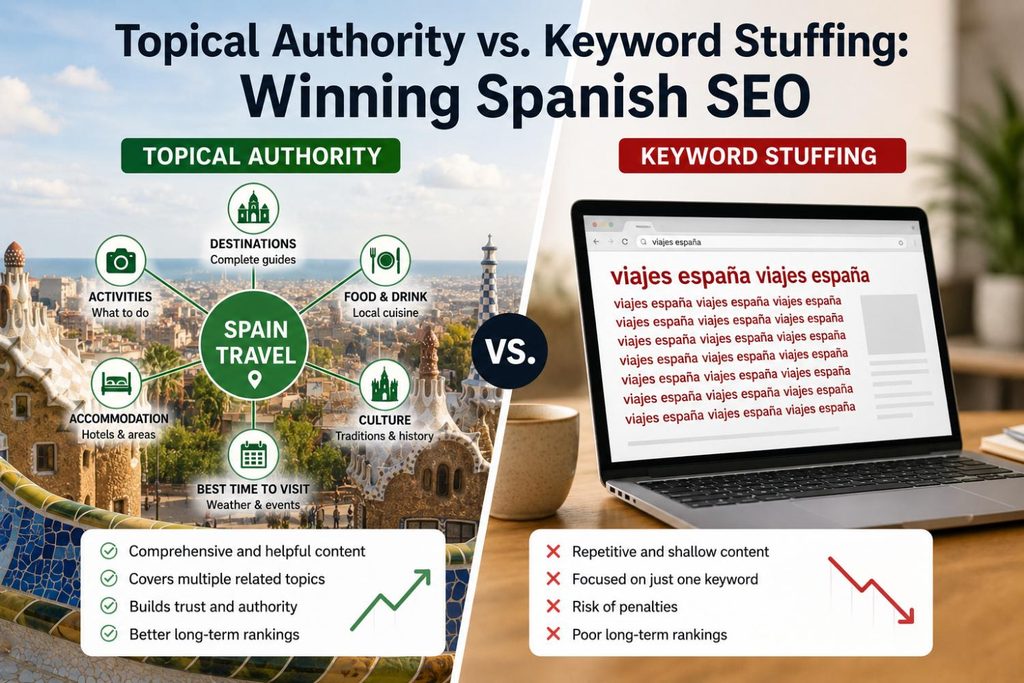
Keyword stuffing is dead. Across the diverse Spanish-speaking web, modern algorithms reward authentic topical depth and regional linguistic nuance over repetitive phrase matching.
🎯 Master semantic search, build genuine subject-matter expertise, and navigate cultural variations across Spain and Latin America successfully. 🚀✨
What Keyword Stuffing Actually Was (and Why It Worked, Briefly)
To understand why the old approach is dead, it helps to remember why it ever worked at all.
Early Search Engines
Early search engines were fundamentally pattern-matching systems. They looked at a page, counted term frequency, checked prominent placement (titles, headers), and used that as a proxy for relevance.
Exact Phrase Overload
If you wanted to rank for “seguros de coche baratos,” the playbook was simple: use that exact phrase as often as possible across as many prominent areas as you could get away with.
Optimized for Machines
This created ecosystems optimized for code rather than humans: repetitive, awkward, and genuinely unhelpful text that somehow managed to rank for a brief period.
1. Semantic Understanding
Google’s algorithms evolved from lexical matching to deep semantic comprehension — recognizing that “seguros de coche” and “seguro de auto” are conceptually identical without needing exact repetitions.
2. User Behavior & Signals
User data began feeding back into rankings. If visitors bounced immediately because a stuffed page failed to answer their query, performance degraded regardless of keyword density on paper. 🚀
The Shift to Modern Contextual SEO
Search engines transformed from rigid mechanical counters into complex semantic engines. Here is how modern ranking logic evaluates content value.
Search Intent Optimization
Algorithms now decode the user’s underlying goal behind a query — informational, transactional, or navigational — delivering content that directly solves their need.
Topical Authority & Entities
Instead of matching isolated strings of text, modern systems map relationships between concepts, rewarding sites that comprehensively cover a subject across related sub-topics.
Engagement & Experience
Dwell time, interaction rates, and frictionless reading experiences act as direct feedback loops, ensuring only genuinely helpful content sustains top positions.
The Bottom Line for Content Creators
Writing for humans first has become the ultimate technical SEO strategy. When you build clear, authoritative, and deeply satisfying resources, modern search algorithms reward you naturally. 🚀
Why This Matters More in Spanish SEO Specifically
There are a few reasons the topical authority shift lands with particular force in the Spanish-speaking market.
Regional & Dialectal Variation
A page for Madrid vs. Guadalajara might use different vocabulary, currency, regulations, and tone. Building separate content clusters for different regions wins over bloated multi-dialect pages.
Intensified Competition
The Spanish-language web has matured with major international publishers, funded local players, and AI-assisted content. Thin, keyword-stuffed pages stand no chance against comprehensive resources.
Conversational Search Behavior
Voice search and question-based mobile queries (e.g., “cómo funciona el seguro de coche si tengo un accidente”) reward direct, natural-language answers rather than raw keyword density.
Machine Translation Penalty
Low-quality content from machine-translated English is easily spotted by users and search engines alike due to awkward phrasing and false cognates. Genuine authority requires native writing or careful localization.
Building Topical Authority: A Practical Framework
A step-by-step strategy that holds up whether you’re working on a small niche site or a large publisher property.
Map the Topic, Not Just the Keyword
Map out the full ecosystem of a subject like an expert. Instead of a single keyword like “hipotecas,” build an entire content architecture covering rates, regulations, taxes, and buyer programs.
Build Content Clusters, Not Isolated Pages
Structure content around authoritative pillar pages linked to detailed subtopic articles. This internal linking guides both users and search engines through deep topical depth.
Write for the Specific Reader, in Their Spanish
Tailor vocabulary, currency, legal references, and cultural nuances to your target region (Spain, Mexico, Argentina) using structured subdirectories or subdomains.
Demonstrate Expertise, Not Just Coverage
Include concrete numbers, realistic examples, regulatory references (like the Banco de España), and author credentials to signal genuine, undeniable authority.
Maintain and Update, Don’t Just Publish
Audit and refresh content regularly to account for shifting regulations, updated statistics, and newly emerged subtopics over time.
Earn Links and Mentions Through Genuine Value
Create original research, comprehensive guides, or useful calculators that naturally attract credible backlinks rather than chasing low-quality link schemes.
Common Mistakes That Look Like Progress But Aren’t
A few patterns are worth calling out because they can feel like topical authority-building while actually being keyword stuffing in disguise.
Publishing Volume Without Structure
Churning out fifty articles on loosely related subtopics without a clear pillar structure or intentional internal linking doesn’t build authority — it just creates a meaningless pile of content.
AI Content Without Oversight
AI tools help with research and drafting, but publishing minimal-effort text without human expertise, fact-checking, or localization reads as generic and undermines trust in nuanced Spanish-speaking markets.
Synonym-Stuffing as “Semantic SEO”
Cramming every synonym (“coche,” “auto,” “vehículo,” “automóvil”) into the same paragraph without real reason isn’t semantic sophistication — it’s the same old problem wearing a new label.
Ignoring Regional Nuance for Scale
Writing one “universal” Spanish piece saves time and cost, but it often produces content that feels foreign to every regional audience, undermining the trust authority is meant to build.
The Bigger Picture
The shift from keyword stuffing to topical authority isn’t a trick or a new tactic — it’s SEO converging with what good content has always required.
Expertise Meets Search
Good content has always required genuine expertise, clear structure, and real respect for the reader’s specific context. In the Spanish-language market, this convergence carries extra weight due to regional nuance and a higher competitive bar.
Subjects Over Keywords
Stop thinking in terms of individual keywords and start focusing on subjects you can credibly claim to understand better than anyone else publishing on them — for a specific audience, in their specific Spanish.
The Path That Holds Up
Building true topical authority is a harder path than stuffing title tags with target phrases five times. But it is also the only strategy that holds up, both with search engines getting better at spotting the difference and with readers who were never fooled by old tricks. 🚀
Topical Authority vs. Keyword Stuffing: 15 FAQs
Explore essential questions about modern Spanish SEO, building real subject-matter authority, avoiding outdated tactics, and mastering regional linguistic nuances.
01 What is keyword stuffing and why did it work historically?
Keyword stuffing is the practice of repeatedly inserting exact-match search terms into a webpage to manipulate rankings. It worked briefly because early search engines relied on rigid mechanical pattern matching rather than contextual comprehension.
02 How do modern search engines evaluate relevance today?
Modern algorithms use deep semantic understanding and entity mapping. They recognize conceptual relationships, search intent, and topical depth without requiring exact keyword repetition.
03 What is topical authority in the context of SEO?
Topical authority is a site’s demonstrated comprehensive expertise across an entire subject ecosystem, proving to search engines that you cover a topic better than anyone else.
04 Why does topical authority matter even more in Spanish SEO?
The Spanish-language web features intense competition, regional dialectal variations, and diverse legal or financial frameworks, raising the bar far beyond generic keyword targeting.
05 How do you map a topic instead of just targeting keywords?
Instead of picking isolated phrases, you map out the entire ecosystem of a subject—such as subtopics, regulations, taxes, and user problems—the way a true industry expert would think about it.
06 What role do content clusters play in building authority?
Content clusters organize information around broad pillar pages linked to detailed subtopic articles. This internal linking structure signals depth and guides users smoothly to specific answers.
07 Why is writing in the reader’s specific Spanish dialect crucial?
Vocabulary, currency, legal references, and cultural nuances differ dramatically between Spain, Mexico, Argentina, and Colombia. Localized content builds immediate trust and conversions.
08 How do you demonstrate real expertise rather than surface-level coverage?
By including concrete examples, realistic numbers, precise references to actual institutions or regulations, and expert author credentials instead of generic filler text.
09 Why is content maintenance and updating necessary over time?
Regulations change, prices shift, and industries evolve. Regularly auditing and updating strong content prevents authority decay in fast-moving sectors.
10 How should backlinks and mentions be earned under this framework?
Backlinks should be earned organically by creating genuinely valuable assets like original research, comprehensive guides, or useful calculators rather than buying links or low-quality exchanges.
11 What is the “volume trap” mistake in content creation?
Churning out dozens of superficial articles without structural pillar integration or intentional internal linking creates noise rather than true authority.
12 What risks are involved with unedited AI content in Spanish markets?
Publishing minimal-effort AI drafts without human fact-checking or localization results in generic phrasing that fails to connect with Spanish-speaking audiences and damages trust.
13 Is synonym-stuffing considered valid semantic SEO?
No. Cramming every possible synonym into text without adding context or value is simply the old keyword stuffing problem disguised with new terminology.
14 Why do machine-translated English pages underperform in Spanish?
Machine translations often contain false cognates and unnatural sentence structures that are instantly spotted by both human readers and search algorithms.
15 What is the ultimate takeaway for winning Spanish SEO today?
Winning Spanish SEO requires abandoning shortcuts, respecting regional nuance, and aligning content creation with authentic subject-matter mastery to build lasting search authority.
Let’s Scale Your Growth
Ready to dominate search results and maximize your return on ad spend? Drop us a message and our team will get back to you shortly.

Send Us a Message
Fill out the form below and we’ll schedule a discovery call.