
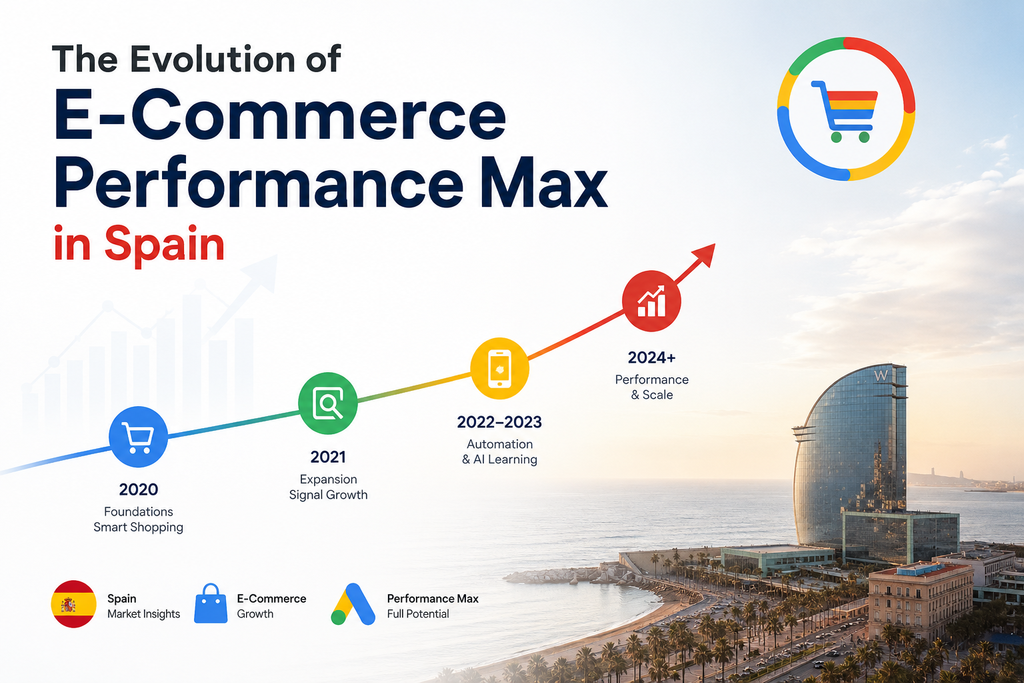
The Evolution of E-Commerce:
Performance Max in Spain
Online sales in Spain are on track to grow 7.4% in 2026, outpacing Western Europe’s 5.8% average and driving total annual turnover past €90 billion across 28.6 million buyers.
As Spanish e-commerce matures into Europe’s standout growth market, Performance Max has evolved from an opaque automation experiment into a steerable growth engine for brands scaling past €3,762 average annual spend per buyer. 📈🇪🇸
Spain’s E-Commerce Growth Trajectory
Surpassing regional benchmarks, Spain is positioned as one of Western Europe’s most dynamic digital retail environments.
Outpacing Western Europe
Spain’s 7.4% online sales growth rate outpaces the 5.8% regional average, pulling ahead of major European markets.
Expanding Digital Retail Volume
Total annual e-commerce turnover has pushed past €90 billion, scaling up toward €110 billion with broader digital retail categories.
Growing Consumer Base
The market currently counts 28.6 million online buyers, a figure projected to climb steadily toward 30.1 million by 2030.
Rising Consumer Value
Average annual spend per buyer has jumped 13.8% year-over-year, reflecting heightened consumer trust and digital adoption.
Where Performance Max Started
When Google rolled out Performance Max globally in 2021 and 2022, it represented a genuine bet on full automation. Instead of building separate campaigns for Search, Shopping, Display, YouTube, Gmail, Discover, and Maps, advertisers fed Google a single pool of assets, budget, and conversion goals, and the algorithm decided where, when, and how to spend across all of Google’s inventory simultaneously.
Cross-Channel Reach for Retailers
For Spanish e-commerce brands — many of them mid-sized retailers without large in-house data science teams — this promised something genuinely useful: cross-channel reach without the operational burden of managing half a dozen campaign types by hand.
The “Black Box” Reality
Performance Max offered almost no visibility into which channel was actually driving results, no easy way to exclude poor-performing placements, and none of the granular control that Search and Shopping advertisers had spent years learning to rely on.
Adoption Resistance in Spain
For a market like Spain, where digital marketing budgets have historically been more conservative and ROAS scrutiny tends to be high, that opacity was a real obstacle to adoption. Many performance-driven retailers kept Standard Shopping campaigns running in parallel, unwilling to hand full control to an algorithm they couldn’t audit.
The Turning Point: 2024–2025
The first meaningful cracks in the black box appeared in late 2024 and early 2025. Google introduced campaign-level negative keywords for the first time, giving advertisers a way to block obviously irrelevant traffic without waiting for algorithmic learning to sort it out. Search theme inputs — a way of nudging the algorithm toward specific query intent — doubled from 25 to 50 per asset group, giving advertisers considerably more room to shape discovery without writing traditional keyword lists.
The Shift to Pure Ad Rank
Historically, PMax had an unofficial priority advantage: when a PMax campaign and a Standard Shopping campaign could both serve the same impression, PMax tended to win by default, regardless of which one was actually better optimized.
Leveling the Playing Field
At the end of 2024, Google shifted this to a pure Ad Rank model — bid multiplied by Quality Score multiplied by the expected impact of assets — meaning the campaign with the strongest overall rank wins the auction, not the campaign type Google happens to favor.
The Rise of Deliberate Hybrid Execution
That single change reset the competitive relationship between Performance Max and Standard Shopping, and it’s a large part of why a genuine hybrid strategy — running both campaign types deliberately, rather than being forced into one by default prioritization — became viable for the first time.
What 2026 Changed
If 2024–2025 cracked the black box, 2026 has been the year Google systematically dismantled it. Several updates landed in quick succession, and together they represent the most substantial shift in Performance Max’s control and transparency since launch.
Full Negative Keyword Support
Advertisers can now add negative keywords directly to Performance Max campaigns — at the campaign level, account level, or through shared lists — with broad, phrase, and exact match types. This closes one of the oldest complaints about PMax by enabling the blockage of non-purchase-intent searches that quietly drained budget.
Channel-Level Performance Reporting
Advertisers can now see exactly how budget is distributed and performing across Search, Shopping, Display, YouTube, Gmail, Discover, and Maps within a single campaign rather than receiving blended results. This transforms the optimization conversation from guesswork into direct diagnosis.
Customer Match Exclusions
Uploading a Customer Match list now functions as an absolute rule rather than a mere suggestion, letting brands exclude existing buyers entirely. For Spanish retailers running loyalty programs, this allows a clean separation between prospecting and retention spend.
URL-Contains & Placement Exclusions
Feed-based PMax campaigns can apply “URL contains” rules to target specific categories or page types directly — such as isolating a seasonal “rebajas” page. Account-level exclusions also address frustration by letting brands block specific display placements and search partner sites.
Demographic Exclusions & Creative Limits
Age and gender exclusions can now be applied at the campaign level for product lines skewing toward specific audiences. Additionally, video asset limits per asset group increased from 5 to 15, providing expanded messaging flexibility without requiring extra campaigns.
Formal Experimentation Tools
Google introduced native PMax experiments, allowing structured A/B testing against existing campaigns, URL expansion tests, and incremental uplift measurement. This brings statistical rigor to testing that previously relied on rough before-and-after comparisons.
Why This Matters Specifically for Spain
These changes land at a particularly consequential moment for the Spanish market. Four core dynamics make Spain a distinctive context for this digital evolution.
Mobile-First Behavior Demands Precise Targeting
Spain has one of the highest mobile commerce penetration rates in Europe (83.6% shopping primarily via smartphone, ahead of the global average of roughly 77%). PMax’s channel-level reporting lets advertisers verify whether mobile channels like Discover and YouTube Shorts placements are actually converting at rates that justify the spend.
Cross-Border Competition is Intensifying
International marketplaces like Temu and AliExpress are gaining meaningful share among Spanish consumers, driving Spain’s above-average e-commerce growth forecast. New negative keyword and URL-contains controls give domestic retailers sharper tools to protect budgets from low-intent bargain hunters.
The Market is Maturing, Not Just Growing
Seventy-four percent of Spanish companies expect online sales growth, but optimism is paired with rising acquisition costs. A maturing, margin-conscious market demands technological differentiation and operational discipline — precisely what PMax’s new controls enable.
The Rise of Social Commerce Surfaces
Social commerce is consolidating as a primary growth lever in Spain. Performance Max’s cross-channel reach across YouTube, Display, and Discovery surfaces positions it well to capture that shift, provided advertisers can measure performance accurately.
The Hybrid Strategy: Standard Shopping and Performance Max Together
Perhaps the most important strategic shift for Spanish e-commerce advertisers isn’t any single Performance Max feature, but the broader move away from an all-or-nothing choice between Standard Shopping and Performance Max.
Auction Model Alignment
With the Ad Rank auction model now governing both, the two campaign types can coexist deliberately rather than competing for default priority, allowing campaigns to complement each other smoothly.
Deliberate Division of Labor
Standard Shopping handles known-intent traffic while Performance Max drives full-funnel discovery across surfaces. Brands running multi-campaign architectures report 35–55% higher ROAS than single-setup runners.
Practical Segmentation
Run Standard Shopping for core best-sellers with strong conversion history, while Performance Max handles seasonal collections, new product launches, and broader brand-awareness objectives.
Practical Recommendations for Spanish E-Commerce Advertisers
For teams managing Performance Max campaigns in the Spanish market today, a disciplined sequence of priorities stands out to maximize efficiency and protect margins.
Audit Search Terms Methodically
Audit search term data as soon as it’s available and build out negative keyword lists methodically — Spanish-language query patterns, regional terms, and marketplace-adjacent searches (comparisons with Temu or AliExpress, for instance) are worth excluding early rather than waiting for the algorithm to self-correct.
Separate Acquisition from Retention
Use the new Customer Match exclusion capability to separate acquisition from retention reporting. This is particularly relevant for brands running loyalty programs, which are becoming more common as Spanish retailers compete on retention rather than just acquisition in a maturing market.
Validate via Channel-Level Reporting
Lean on channel-level reporting to validate — rather than assume — mobile and social-adjacent placement performance, given how mobile-dominant Spanish shopping behavior has become.
Avoid PMax Isolation
Resist the temptation to run Performance Max in isolation. The data increasingly supports a hybrid architecture where Standard Shopping and Performance Max are deployed for different jobs within the same account, rather than treating PMax as a full replacement for a considered campaign structure.
Institutionalize Native A/B Testing
Treat Google’s new native experimentation tools as a standing part of the workflow rather than a one-off test. As Performance Max continues to evolve, structured A/B testing is the most reliable way to confirm whether a given feature or setting actually improves results for a specific catalog and audience, rather than relying on Google’s own recommendations or general best practices that may not translate to a Spanish market with its own competitive and behavioral quirks.
Conclusion
Performance Max’s evolution in Spain mirrors the evolution of the Spanish e-commerce market itself: a shift from rapid, forgiving growth toward a more mature, competitive, and detail-oriented phase.
From Black Box to Control
The campaign type that once asked advertisers to hand over budget and trust the algorithm has become something closer to a genuinely steerable system — provided advertisers actually use the controls now available to them.
Capturing Spain’s Next Phase
For Spanish e-commerce brands operating in a fast-growing economy facing cross-border competition, steerability is the difference between a growth engine and an expensive black box. The tools now exist to capture Spain’s next phase of growth.