
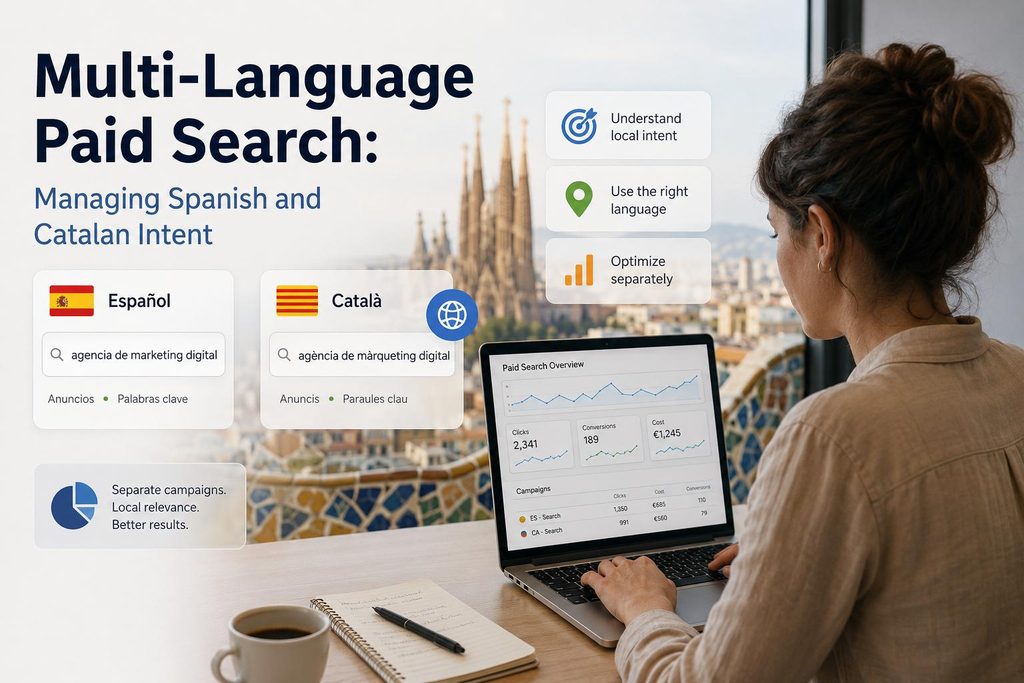
Multi-Language Paid Search:
Managing Spanish & Catalan Intent
Treating Spain as a linguistically homogeneous market leaves performance on the table in Catalonia, Valencia, and the Balearic Islands where Catalan search intent drives high-value consumer decisions.
Master bilingual campaign architecture to capture both Spanish and Catalan audiences without cannibalizing budgets, diluting Quality Score, or inflating keyword lists. 🌐🎯
Multi-Language Paid Search: Managing Spanish & Catalan Intent
A comprehensive framework for advertisers and agencies targeting bilingual Spanish markets. Discover why language segmentation drives higher efficiency, regional trust, and lower CPCs in Catalonia, Valencia, and the Balearic Islands.
Where Catalan is co-official and preferred online.
Fewer dedicated Catalan campaigns mean reduced CPCs.
Distinguishing local cultural searches from global queries.
Why Segmentation Matters
Language is not a simple translation layer; it proxies regional trust, distinct search behavior, and lower competitive friction in local service and retail sectors.
Clean Campaign Structure
Separate campaigns by language under the same account to isolate bids, Quality Scores, and testing metrics while utilizing cross-language negative lists.
Native Parity & Bidding
Avoid machine translation flaws and landing page mismatches by writing natively and protecting your testing budget for at least one full quarter.
The Strategic SEO Summary
Treating Spanish-Catalan search intent as a structural segmentation challenge rather than a literal translation task unlocks under-competed market share, better conversion rates, and maximized ROAS.
Why Language Segmentation Is Not Optional in Catalan-Speaking Regions
Catalonia has a population of roughly 7.7 million people, and Catalan is a co-official language alongside Spanish. Government data and regional surveys consistently show that a substantial share of the population—particularly outside Barcelona’s urban core, in smaller cities like Girona, Lleida, and Tarragona—uses Catalan as their first or preferred language in daily life, including online.
This matters enormously for paid search because language is not merely a translation layer sitting on top of identical intent. It is a proxy for several things advertisers care about:
Regional Identity & Local Trust
Catalan-language ads and landing pages signal that a business understands and respects local culture. This is especially relevant for service businesses, tourism, real estate, and local retail, where trust and cultural fit directly influence conversion rates.
Search Behavior Differences
Catalan speakers frequently search in Catalan for local or cultural topics (restaurants, events, local news, government services) but switch to Spanish for national or international topics (banking, insurance, large e-commerce platforms). This code-switching behavior means a single-language campaign will systematically miss a meaningful slice of high-intent queries.
Lower Competition & CPCs
Because far fewer advertisers bother building dedicated Catalan-language campaigns, the competitive density on Catalan keywords is frequently much lower than on their Spanish equivalents. This can translate into materially lower cost-per-click and better ad positions for the same budget.
Legal & Public Sector Considerations
For businesses working with public institutions, universities, or Generalitat-linked entities in Catalonia, Catalan-language presence can be a procurement or compliance consideration, not just a marketing nicety.
The Real Cost of Ignoring Segmentation
Ignoring this segmentation doesn’t just mean missing incremental volume—it means systematically under-serving a portion of the addressable market that may convert at different rates, respond to different messaging, and search with entirely different vocabulary than assumed.
The Core Problem: Intent Doesn’t Translate One-to-One
The naive approach to multilingual paid search is to take a Spanish keyword list, run it through a translation tool, and launch a parallel Catalan campaign. This fails for several structural reasons.
Query Volume Asymmetry
Some categories see heavy Catalan search volume (local services, cultural events, regional tourism, public administration), while others see almost none (highly technical B2B terms, global brand searches, certain e-commerce categories where Spanish dominates even among Catalan speakers). A blind translation wastes budget building out keyword lists for terms nobody actually searches in Catalan, while potentially missing genuinely high-volume Catalan-specific phrasing that has no direct Spanish equivalent in usage pattern.
Different Modifiers & Question Structures
The way people phrase comparative or transactional queries differs. “El millor” versus “el mejor,” “preu” versus “precio,” “a prop meu” versus “cerca de mí” — these aren’t just vocabulary swaps, they carry different search volumes, different match behavior in Google’s system, and sometimes different commercial intent signals. A query in Catalan asking about “millor assegurança cotxe” may skew toward comparison-stage users, while the Spanish equivalent might carry a broader mix of intent stages depending on the region searching it.
Code-Switching Within Sessions
It’s common for a single user to search in Catalan for informational queries and then switch to Spanish for the transactional or brand-name query later in the same session, particularly when a brand’s own site or major competitors only operate in Spanish. This means Catalan and Spanish campaigns are not fully independent audiences — they’re overlapping journeys, and attribution needs to account for that rather than treating each language as a silo with a clean, separate funnel.
Auto-Translated Ad Copy Reads as Inauthentic
Machine-translated Catalan ad copy is often detectable to native speakers, especially around idiomatic phrases, calls to action, and regional vocabulary preferences (Barcelona-standard Catalan differs slightly from Valencian or Balearic usage). Poor translation undermines exactly the trust signal that made investing in Catalan campaigns worthwhile in the first place.
The Strategic Reality
Recognizing that intent shifts across language lines prevents wasted ad spend and ensures messaging resonates authentically with regional audiences.
Building the Campaign Architecture
There is no single “correct” structure, but a few architectural patterns consistently perform well for advertisers serious about Spanish-Catalan bilingual markets.
Separate Campaigns by Language
The most common and generally recommended structure is full campaign-level separation by language under the same overall account and budget planning process.
The Tradeoff: Enables independent bids, Quality Scores, and ad testing, but adds management overhead with two sets of keywords, ads, and negative lists.
Geo-Based Campaigns with Language Ad Groups
For advertisers preferring geographic structuring (common in retail and local service businesses with physical locations), language can instead be handled at the ad group level.
The Tradeoff: Works well when budget ties directly to store geography, but makes isolated language-level reporting harder since ad group reporting is less prominent.
Handling Geographic Overlap & Cross-Contamination Control
Google Ads location targeting relies on physical or presumed location, not language preference. A user in Barcelona can search in Spanish or Catalan regardless of geo-targeting.
Target Catalonia, Balearic Islands, and Valencia broadly, letting keyword and ad language do the intent-matching.
Use campaign language settings as a coarse browser/UI filter to reduce mismatch.
Negative Keywords are Essential: Add the entire Spanish keyword list as exact/phrase negatives into the Catalan campaign and vice versa to prevent algorithm bleed on shared brand terms, numbers, or borrowed English words.
Keyword Research: Getting Beyond Direct Translation
Effective Catalan keyword research requires going beyond a translated seed list.
Start with Native-Language Tools & Autocomplete
Ideally pull autocomplete and “people also search” data specifically for Catalan queries rather than assuming translated volume estimates are accurate. Google Keyword Planner shows Catalan search volume when queries are entered in Catalan and location is set correctly, but volumes are often understated for regional languages due to how Google buckets smaller-volume terms — treat the numbers as directional, not absolute.
Mine Actual Search Term Reports
Once campaigns are live, this is often more revealing than pre-launch research: real Catalan search term data shows actual phrasing, question structures, and long-tail variants people use, which frequently differs from what a translation-first approach would have predicted.
Consult Native Speakers for Terminology
Certain industries have Catalan-specific terminology that isn’t a direct translation of the Spanish term. Legal, medical, and public administration categories are particularly prone to this, where the “official” Catalan term used by the Generalitat differs meaningfully from a literal translation.
Watch for Dialectal Variation
Valencian and Balearic Catalan have vocabulary and spelling differences from standard (Barcelona-based) Catalan. For advertisers targeting Valencia specifically, it’s worth testing whether Valencian-specific phrasing outperforms standard Catalan phrasing, particularly for hyper-local service categories.
The Keyword Research Imperative
Moving beyond literal translations ensures your ad groups capture genuine local search behavior, accurate long-tail phrasing, and regionally accepted terminology.
Ad Copy and Landing Page Considerations
Keyword-level language matching only pays off if the surrounding experience — ad copy, extensions, and landing page — is genuinely native, not translated.
Write Natively, Never Translate
This applies to headlines, descriptions, and especially calls to action, where idiomatic phrasing carries a lot of the persuasive weight. A literal translation versus a naturally-written Catalan CTA can perform noticeably differently in click-through rate, even though both are technically correct.
Landing Pages Need Full Language Parity
Sending Catalan-ad clicks to a Spanish-only landing page (or a page with a small, easy-to-miss language toggle) creates a jarring mismatch that increases bounce rate and can also hurt Quality Score, since Google’s landing page relevance signal factors in language consistency between ad and destination.
Structured Data & Hreflang Tags
If the site has both Spanish and Catalan versions, correct hreflang implementation ensures Google understands which page version to associate with which language, which indirectly supports paid Quality Score by reinforcing topical and linguistic relevance signals site-wide.
Localize Sitelinks, Callouts & Snippets
It’s common to see well-executed Catalan headlines paired with Spanish-only ad extensions — this inconsistency is easy to miss in an ad copy review but is visible to the searcher and undermines the localization effort.
The Seamless User Journey
Maintaining linguistic consistency from the initial search query all the way through to the final checkout or contact form ensures higher conversion rates and maximum Quality Score efficiency.
Bidding and Budget Allocation Strategy
Once campaigns are properly segmented, bidding strategy should reflect the different competitive and volume dynamics of each language.
Manual or Target CPA Bidding First
Start with manual or Target CPA bidding during the learning phase for the Catalan campaign specifically. Lower search volume means automated strategies like Target ROAS or Maximize Conversions may struggle to exit the learning phase on a thin dataset. Once you reach the standard 30-conversions-per-month threshold, transitioning to automated bidding becomes viable.
Expect Different CPCs & Adjust Budgets
Because competitive density is typically lower on Catalan keywords, CPCs are often lower, but so is absolute volume. Budget allocation should not be a simple population-proportional split; it must be informed by actual observed volume and conversion rate data once live, revisited quarterly.
Don’t Starve the Catalan Campaign
Because absolute volumes are smaller, it’s tempting to under-fund the Catalan campaign relative to the Spanish one from day one. This creates a self-fulfilling data problem — insufficient spend produces insufficient data, justifying further under-investment. Give it a genuine testing budget for at least one full quarter.
Consider Dayparting & Seasonality
Catalan search behavior can show different patterns around regional holidays (La Diada, Sant Jordi) compared to national Spanish holidays. Campaigns tuned only to national seasonality calendars risk missing valuable regional demand spikes.
Balancing Multi-Language Budgets
Aligning your bidding mechanisms with regional volume realities ensures sustainable data collection without premature budget cutbacks.
Measurement: Isolating Language Performance Cleanly
To actually evaluate whether the Catalan investment is paying off, reporting needs to isolate language as a clean dimension.
Consistent Naming Standards
Tag campaigns and ad groups with consistent naming conventions (e.g., [CAT] and [ES] prefixes) so language is instantly filterable in any reporting view without relying on manual tagging after the fact.
Granular Conversion Tracking
Set up conversion tracking that can be segmented by campaign, not just aggregated at the account level, so language-specific conversion rate, cost-per-conversion, and ROAS can be compared directly.
Watch Assisted Conversions
Watch assisted conversions and cross-campaign paths in Google Ads’ or GA4’s path reports, since the same user may interact with both language campaigns across a research-to-purchase journey. Attribution modeling that only credits last-click within a single campaign will understate the Catalan campaign’s actual contribution if it frequently plays an earlier, informational role in the funnel.
Benchmark Quality Score Separately
Benchmark Catalan campaign Quality Score components (expected CTR, ad relevance, landing page experience) separately from Spanish, since these are genuinely different auctions with different competitive baselines, not a subset of the same auction.
The Analytical Imperative
Clean data structures and multi-touch attribution models ensure that regional investments receive accurate credit for driving high-value customer journeys.
Common Mistakes to Avoid
Steer clear of these foundational pitfalls to ensure your bilingual Spanish-Catalan paid search campaigns drive maximum profitability.
Treating Catalan as a “Nice to Have”
In regions where Catalan search share is substantial, under-resourcing it isn’t a minor optimization miss — it’s leaving a structurally under-competed, often cheaper acquisition channel on the table.
Relying Entirely on Machine Translation
This is the single most common failure mode, producing campaigns that technically exist in Catalan but perform poorly because they don’t actually speak the language the way native searchers do.
Failing to Build Cross-Language Negatives
Neglecting cross-language negative keyword lists leads directly to internal cannibalization and messy attribution tracking between the two campaigns.
Applying a Single National Strategy
Using a uniform national bidding and budget strategy without accounting for the different volume and competitive dynamics between Spanish and Catalan auctions compromises efficiency.
Neglecting Landing Page Localization
Failing to localize landing pages and post-click experiences undoes much of the credibility gained from well-localized ad copy the moment a Catalan-language ad click lands on a Spanish-only page.
Conclusion
Managing Spanish and Catalan search intent within a single market is fundamentally a segmentation problem disguised as a translation problem.
Beyond Translation
Advertisers who treat it as “translate the Spanish campaign” consistently under-perform relative to those who treat it as building two genuinely distinct campaigns — with their own keyword research, native ad copy, bidding logic, and measurement framework, tied together by careful negative keyword hygiene.
Unmatched Efficiency
For advertisers operating in Catalonia, the Balearic Islands, or the Valencian Community, this isn’t a niche optimization — it’s addressing a meaningful, often under-competed share of the addressable market with a level of linguistic and cultural precision that most competitors still aren’t bothering to match.
The Ultimate Payoff
Done properly, the payoff is not just incremental volume, but often materially better efficiency, since fewer advertisers are bidding seriously in the Catalan-language auction at all.
Frequently Asked Questions: Spanish & Catalan Paid Search
Everything you need to know about navigating language segmentation, campaign architecture, and bidding dynamics in bilingual Spanish markets.
01 Why is language segmentation important in Catalan-speaking regions?
Catalonia has a population of roughly 7.7 million people where Catalan is co-official. Substantial shares of the population—especially outside Barcelona in cities like Girona, Lleida, and Tarragona—prefer Catalan daily, meaning language segmentation drives regional trust, distinct search behavior, and lower competition.
02 What is query volume asymmetry in multilingual paid search?
Query volume asymmetry means some categories see heavy Catalan search volume (local services, cultural events, public administration), while others see almost none (highly technical B2B terms or global brand searches). Blind translation wastes budget on dead keywords while missing unique local phrasing.
03 How do modifier and question structures differ between Spanish and Catalan?
Transactional modifiers differ significantly, such as “el millor” versus “el mejor”, “preu” versus “precio”, or “a prop meu” versus “cerca de mí”. These carry different search volumes, match behaviors in Google’s systems, and distinct commercial intent signals.
04 What is code-switching within user sessions?
Code-switching occurs when a single user searches in Catalan for informational queries, then switches to Spanish for transactional or brand queries later in the same session. This means Spanish and Catalan campaigns are overlapping customer journeys rather than independent silos.
05 What is the recommended campaign architecture for bilingual markets?
Option 1 (Full campaign-level separation by language under the same account) is generally recommended. It features Campaign A for Spanish (National + Regional) and Campaign B for Catalan (Catalonia, Balearic Islands, Valencia), allowing independent bids, Quality Scores, and ad testing.
06 How does geo-based campaign structuring work as an alternative?
Option 2 structures campaigns by geography (e.g., a Catalonia campaign with separate Spanish and Catalan ad groups). This fits retail or local service businesses with physical store footprints tied to regional budgets, though isolated language reporting becomes less prominent.
07 How should I handle geographic targeting overlap between languages?
Google Ads location targeting relies on physical location rather than language preference. Target Catalonia, Balearic Islands, and Valencia broadly for both campaigns, letting the keyword and ad copy language do the intent-matching work.
08 Why are cross-language negative keyword lists essential?
Google’s broad and phrase match algorithms bleed across languages on brand terms, numbers, or borrowed English words. Adding the entire Spanish keyword list as exact and phrase negatives into the Catalan campaign (and vice versa) prevents internal cannibalization and muddy data.
09 How should keyword research be conducted for Catalan queries?
Go beyond translated seed lists by using native-language autocomplete data, mining live search term reports, consulting native speakers for official Generalitat terminology, and checking for dialectal variations like Valencian or Balearic phrasing.
10 Why is machine-translated ad copy a major risk?
Machine-translated Catalan ad copy is often detectable to native speakers, especially around idioms, CTAs, and regional preferences. Poor translation undermines the local trust signal that makes investing in Catalan campaigns worthwhile.
11 What landing page and technical considerations apply to multilingual setups?
Landing pages require full language parity rather than small toggles to protect Quality Score and conversion rates. Correct hreflang implementation, structured data, and localized ad extensions (sitelinks, callouts) ensure site-wide linguistic consistency.
12 What bidding strategy should be used for Catalan campaigns?
Start with manual or Target CPA bidding during the learning phase because lower search volumes can trap automated smart bidding models. Once a stable threshold of conversions is reached, automated bidding becomes viable.
13 How do I avoid starving the Catalan campaign of budget?
Avoid population-proportional splits or underfunding due to lower absolute volumes. Insufficient spend creates a self-fulfilling data problem; give the Catalan campaign a genuine testing budget for at least one full quarter before reallocating.
14 How should language performance be isolated in reporting?
Use consistent campaign naming prefixes like [CAT] and [ES], segment conversion tracking by campaign, monitor cross-campaign path reports for multi-touch attribution, and benchmark Quality Score components independently.
15 What are the most common pitfalls to avoid in bilingual search?
Common mistakes include treating Catalan as a minor add-on, relying entirely on machine translation, failing to build cross-language negative keyword lists, applying a uniform national budget, and neglecting landing page localization.