
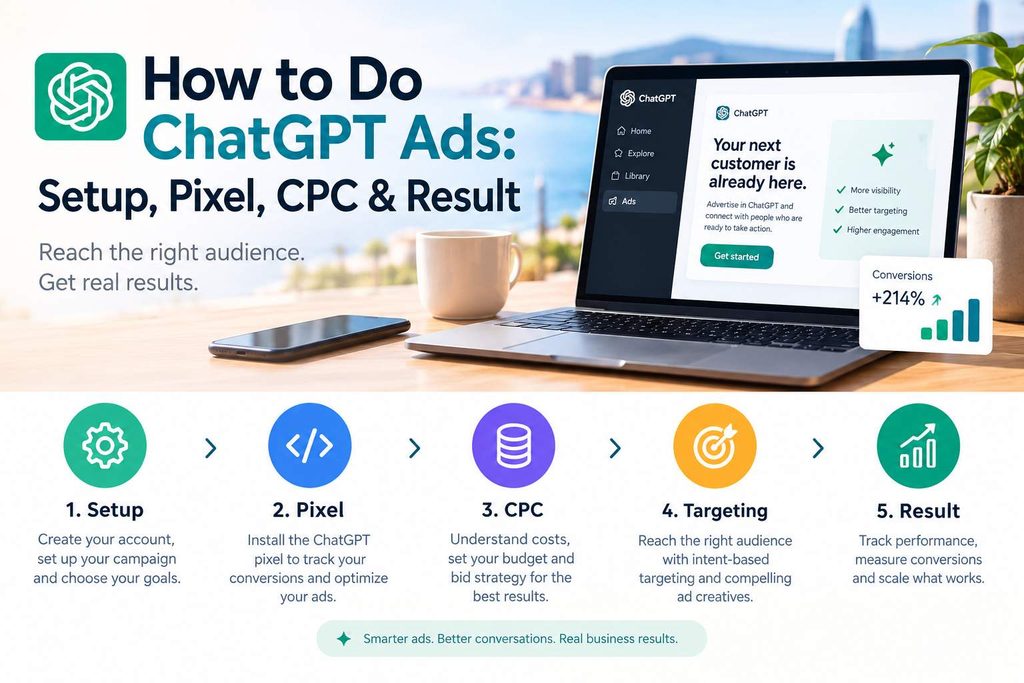
How to Do ChatGPT Ads
Setup, Pixel, CPC & Result
ChatGPT Ads is the newest paid channel in digital marketing, and it didn’t exist a year ago. OpenAI began testing sponsored placements inside ChatGPT for U.S. Free and Go tier users in February 2026, opened a self-serve Ads Manager in May, and by the end of August had crossed a $1 billion annualized revenue run rate while expanding self-service buying to the UK, Mexico, Brazil, Japan, South Korea, and — most recently — India, Europe, the Middle East, and North Africa.
🎯 Master everything needed for your first campaign: setup, bidding, the pixel, expected CPCs, which industries fit best, and whether it’s worth it for ticket-selling tourism businesses. 🚀✨
Why ChatGPT Ads Are Different From Everything Else
Understanding what makes this channel structurally new is the first step before spending a cent on it.
Ads That Live Inside a Dialogue
On Google, you bid on a search term. On Meta, you interrupt a scroll. On ChatGPT, your ad appears in a small, clearly labeled box below an AI-generated answer, matched to the full context of the conversation — not a single keyword, but everything the user has said in that chat: destination, budget, timeline, preferences, and prior turns. The ad never influences the answer itself; OpenAI is explicit that ads run separately from — and do not shape — what ChatGPT tells the user.
A Second-Price, Relevance-Weighted Auction
Every eligible slot is decided through a relevance-weighted second-price auction. Your bid is only one input. Ad quality, landing-page fit, and how well your offer matches the actual conversation also factor into whether you win the placement — which means a smaller advertiser with a tightly relevant offer can out-rank a bigger budget with a generic one.
Tight Character Limits by Design
A ChatGPT ad has six components with hard character limits: a headline (roughly 3–50 characters) and a body (up to around 100 characters), plus a destination link, an optional image, and a call-to-action. There’s no room for a clever multi-line story — the format forces you to lead with the single clearest reason someone should click.
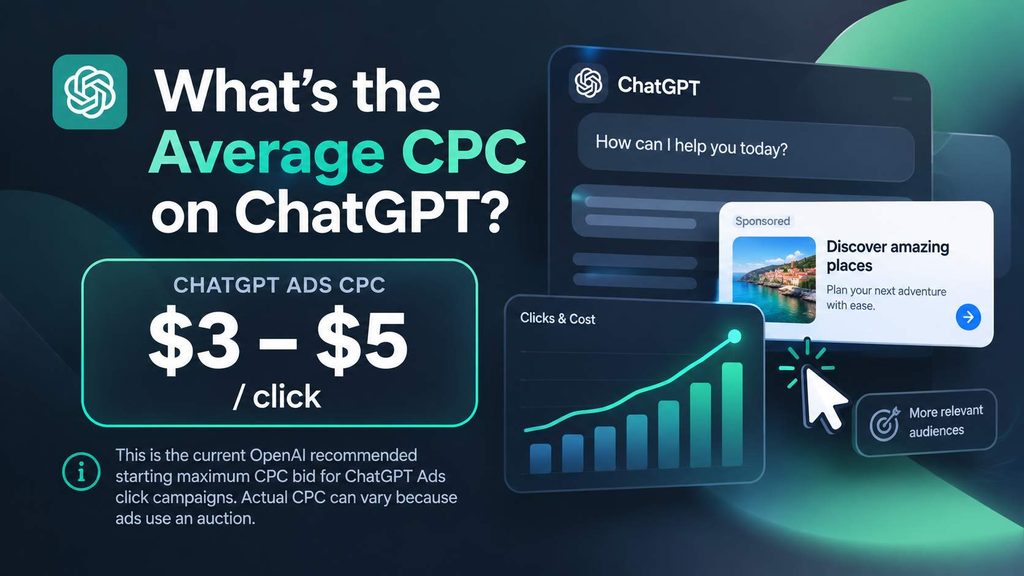
ChatGPT Ads CPC Pricing Breakdown
Analyzing average costs, recommended starting bids, and regional country spreads across live auction data.
Recommended CPC Price
OpenAI’s official platform guidance suggests a starting max CPC bid of $3 to $5 per click for Clicks-objective campaigns to ensure proper auction entry and initial impression delivery.
Average CPC Range
Independent account reporting reveals realized actual CPCs spanning from $3 to $22 across live accounts, heavily influenced by vertical competition, context matching, and ad relevance.
CPC Prices Per Country
Geographic targeting is currently limited to country-level setups spanning the US, UK, Canada, Australia, New Zealand, Latin America, and Europe, with mature regions commanding the upper bound of the $3–$22 range.
Quick Benchmark Matrix
| Metric Type | Price / Range | Platform Status |
|---|---|---|
| Recommended Starting Bid | $3.00 – $5.00 | OpenAI Guidance |
| Realized Average CPC | $3.00 – $22.00 | Live Account Data |
| Geographic Targeting | Country-Level Only | No City/Radius Filter |
How to Make ChatGPT Ads: Step-by-Step
Setting up a campaign is closer to Meta Ads Manager than to Google Ads in terms of interface simplicity, though the targeting logic is genuinely new.
Sign Up at ads.openai.com
Self-serve access is now available to businesses in the US, UK, Canada, Australia, New Zealand, Mexico, Brazil, Japan, South Korea, India, and — since early September — most of Europe, the Middle East, and North Africa. You’ll go through advertiser verification and billing setup before you can launch anything, and several settings (like your objective) can’t be changed once a campaign is live, so plan before you build.
Reach, Clicks, or Conversions
Three objectives exist today: Reach (CPM-priced, for awareness), Clicks (CPC-priced, billed per click), and Conversions (oCPC — billed per click but optimized toward a tracked conversion event such as a purchase, lead, or sign-up). oCPM, the impression-billed version of the conversions objective, is rolling out in beta. For a first test, most advertisers start with Clicks: you only pay for engagement, and you can validate what a ChatGPT visitor actually does on your site before trusting the algorithm to optimize for you.
Campaign-Level Budgets, Ad-Group-Level Bids
Budgets, flight dates, and country targeting sit at the campaign level; bids and “context hints” (signals that help OpenAI match your ad to relevant conversations) sit at the ad-group level. Geographic targeting is currently country-level only — you cannot yet narrow to a state, city, or radius, which matters if your business is genuinely local.
What’s the Average CPC on ChatGPT?
This is the question every advertiser asks first, and the honest answer is that OpenAI hasn’t published official benchmarks — but real account data gives a usable range.
$3–$5 Recommended Starting Bid
OpenAI’s own guidance suggests a starting max CPC bid of $3 to $5 per click for Clicks-objective campaigns. For CPM-priced Reach campaigns, the platform’s default max bid sits around $60 per thousand impressions — noticeably higher than typical display CPMs, reflecting both scarcity of inventory and early-stage demand.
$3–$22 Across Live Accounts
Independent reporting on accounts six months into the platform found actual CPCs ranging from roughly $3 to $22, depending on vertical, competition for context, and how tightly the creative matches the conversation it’s shown in. That’s a wide spread – wider than you’d see on a mature platform like Google Search – because OpenAI hasn’t published benchmarks by industry, so there’s no shared reference point yet for what “efficient” looks like in your category.
Relevance Moves the Price
Because the auction is relevance-weighted, two advertisers bidding the same amount in the same category can end up paying very different effective CPCs depending on how well their ad and landing page match the conversations they’re shown against. This rewards precise context hints and tightly aligned creative over simply outbidding competitors.
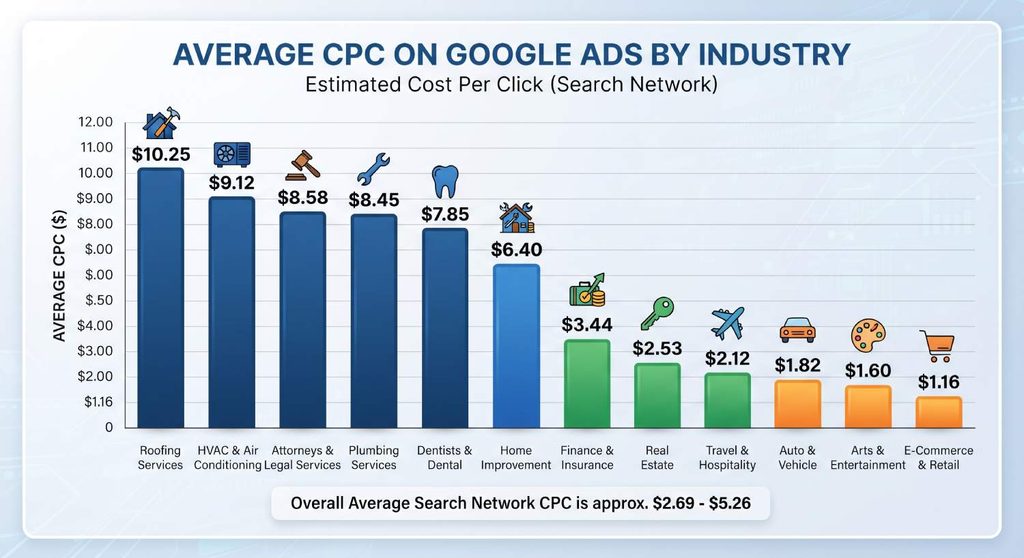
What’s the Average CPC on Google Ads?
Unlike newer AI platforms with sparse public data, Google Ads has decades of mature industry benchmarks that serve as a baseline for digital marketers.
Search Network Averages
Across all industries on the Google Search network, the overall average Cost Per Click (CPC) typically ranges between $1.00 and $2.00, heavily dictated by commercial intent.
Competitive Verticals
High-value industries such as Legal, Insurance, and B2B SaaS frequently see average CPCs exceeding $50 to $100+ due to intense keyword competition and high customer lifetime value.
Display Network Averages
Google Display Network (GDN) CPCs are significantly lower—often under $1.00—because banner placements rely on passive browsing rather than direct active search queries.
Google Ads Network Benchmark Matrix
| Network / Channel | Average CPC Range | Intent Level |
|---|---|---|
| Google Search Network | $1.00 – $3.00 | High (Active Intent) |
| High-Value Verticals (Legal/Finance) | $20.00 – $50.00+ | Very High (Commercial) |
| Google Display Network | $0.50 – $1.00 | Passive (Awareness) |
For Which Kind of Business Is This Useful?
ChatGPT Ads aren’t a fit for every category — OpenAI restricts certain sensitive verticals, and the format itself rewards specific kinds of buying decisions.
High-Consideration Categories
B2B software and SaaS, e-commerce and DTC products with a clear “which one is right for me” decision, digital products and online education, local and home services, and travel and entertainment all thrive because trip planning and deep research are naturally conversational, multi-turn, and rich with targeting signals.
Impulse Buys & Restrictions
Low-consideration impulse products lack a real question to match against. Additionally, OpenAI limits restricted categories (like regulated financial products and certain health claims) and hyper-local businesses face hurdles since only country-level geo-targeting is available today.
A Question Worth Answering
The common thread across high-performing categories is that real buyers naturally provide details — budget, timeline, preferences, constraints — at the exact moment of decision. If your product lacks that kind of decision behind it, the conversational advantage disappears.
Is It Good for the Tourism Industry to Sell Tickets?
Travel is one of OpenAI’s approved advertising categories at launch, and the fit runs deeper than most verticals – for one structural reason: trip planning is already a conversation.
People Ask Before They Book
Travelers use planning conversations rather than transactional keyword searches, surfacing exact details like destination, dates, group size, and budget that let an attraction or tour show up as a relevant, timely suggestion instead of an interruption.
Structured Inventory Beats Spend
Because the relevance auction rewards precise matches, businesses maintaining structured, up-to-date data — real-time availability, accurate pricing, and clear inclusions — earn stronger placements than those relying on budget alone.
Dedicated Landing Pages
Top-performing tour businesses build a distinct landing page for each core intent — like skip-the-line tickets or guided tours — keeping offers identical to what the ad promised to consistently outperform generic homepages.
How Does It Work With the Pixel?
Measurement is non-negotiable on ChatGPT Ads: there’s no retroactive attribution, so tracking has to be live before your very first impression.
Browser Pixel & Server-Side API
OpenAI offers two complementary mechanisms: the OpenAI Pixel (distributed as OAIQ) which sets a first-party cookie on your domain, and the Conversions API which handles tracking server-side for resilience against blockers.
Five Steps Before Launch
Essential pre-launch steps include adding UTM parameters to every destination URL, installing the OAIQ pixel via Tag Manager or site snippets, setting up the Conversions API for server-side backup, using dedicated landing pages, and utilizing a shared event ID for deduplication.
Native Metrics & Attribution
Ads Manager reports seven native metrics refreshed hourly, while layering GA4 tracking with chatgpt / cpc source-medium combinations helps counter the natural undercounting of standard last-click attribution models.
What Are the Expected Results?
Because OpenAI hasn’t published cross-advertiser benchmarks by industry, the honest framing is a range of scenarios built from your own numbers — not a single promised outcome.
No Official Benchmarks Yet
OpenAI’s documentation states plainly that the platform does not yet have performance benchmarks across advertisers, industries, or campaign types, leaving you evaluating your account largely against itself over time.
Conservative & Target Cases
Take your historical conversion rates and apply them across a conservative, target, and strong CPC assumption within the $3–$22 observed range to calculate realistic costs per conversion before replacing assumptions with live data.
Engagement Quality & Calibration
ChatGPT-referred visitors spend more time engaging, making raw click volume a poor predictor of results; expect the first two to four weeks of a new campaign to be about calibration and refining context hints.
Can You Run ChatGPT Ads with a Low CPC Bid Like €0.50?
Every advertiser wants to stretch their budget, but understanding the platform’s pricing reality is crucial before attempting ultra-low bids.
The Recommended Starting Bid
OpenAI’s own guidance suggests a starting max CPC bid of $3 to $5 per click for Clicks-objective campaigns, making a €0.50 bid significantly lower than baseline platform recommendations.
Live Account Realities ($3–$22)
Independent reporting on accounts six months into the platform shows actual CPCs ranging from roughly $3 to $22 depending on vertical and competition, meaning a €0.50 bid will likely struggle to win auctions.
Relevance vs. Pure Budget
Because the auction is relevance-weighted, a tighter creative match helps, but an extremely low bid like €0.50 falls well short of early-stage demand and inventory scarcity.
Is ChatGPT Ads Expensive Compared to Google Ads or Bing?
Evaluating cost requires looking at how early-stage demand, inventory scarcity, and relevance-weighted auctions shape pricing relative to mature search platforms.
Higher Starting and Actual CPCs
OpenAI’s recommended starting max CPC bid is $3 to $5, while live accounts see realized CPCs ranging from $3 to $22—a wider and often higher spread than mature platforms like Google Search due to early-stage demand and inventory scarcity.
Elevated Default Reach CPMs
For CPM-priced reach campaigns, the platform’s default max bid sits around $60 per thousand impressions, which is noticeably higher than typical display CPMs found on traditional networks.
Relevance Can Lower Costs
Because the auction is relevance-weighted, a smaller advertiser with a tightly relevant offer and precise context hints can out-rank a bigger budget, potentially lowering effective costs compared to raw bidding wars.
Final Thoughts
ChatGPT Ads occupies a position no other channel currently holds: paid placement inside the exact conversation where someone is actively deciding, rather than searching for or scrolling past your brand.
Rapid Growth
In under 200 days it went from a US-only pilot to a $1 billion run-rate business now expanding into Europe, India, and the Middle East — proving robust advertiser demand even before official benchmarks.
Who Benefits Most
Considered-purchase categories like B2B software, e-commerce with a real story, education, local services, and travel lead the way because buyers naturally supply the conversational detail the matching system rewards.
Measure First
Install the pixel and Conversions API before your first impression, start with the Clicks objective to validate real on-site behavior, and write creative that acts as the single best answer to the specific conversation.
10 Most Frequent Questions About ChatGPT Ads
Direct answers to the most common questions advertisers ask about OpenAI’s advertising ecosystem, matching logic, and performance expectations.
1. Where Do Ads Appear?
Ads appear in a small, clearly labeled box below an AI-generated answer, matched to the full context of the conversation rather than a single standalone keyword.
2. Do Ads Influence AI Answers?
No. OpenAI is explicit that ads run completely separately from — and do not shape or influence — what ChatGPT tells the user in the core chat response.
3. What is the Starting CPC Bid?
OpenAI’s official guidance suggests a starting max CPC bid of $3 to $5 per click for Clicks-objective campaigns to ensure proper auction entry.
Top 10 Frequently Asked Questions Matrix
| # | Question Topic | Core Answer / Detail |
|---|---|---|
| 4 | Average CPC Spread | Realized account CPCs range from $3 to $22 depending on vertical and context matching. |
| 5 | Low Bids (€0.50) | A €0.50 bid is generally too low for current market dynamics and will struggle to win auctions. |
| 6 | Geographic Targeting | Currently restricted to country-level targeting (US, UK, Europe, etc.) with no radius filtering yet. |
| 7 | Best Performing Categories | High-consideration, question-driven sectors like B2B SaaS, travel, and education thrive best. |
| 8 | Pixel & Measurement | Requires the OpenAI Pixel (OAIQ) and Conversions API live before your first impression. |
| 9 | Auction Mechanics | Relevance-weighted second-price auction where ad quality and context fit influence rank. |
| 10 | Comparison to Google/Bing | Initial per-click costs run higher due to early scarcity, but engagement quality is higher. |
Let’s Scale Your E-Commerce Growth
Ready to dominate search results and maximize your return on ad spend in Barcelona? Drop us a message and our team will get back to you shortly.

Send Us a Message
Fill out the form below and we’ll schedule a discovery call.