
What Is GEO?
A Practical Guide to Generative Engine Optimization
It’s the practice of making your content visible, accurately represented, and ideally cited inside the answers produced by AI systems like ChatGPT, Google’s AI Overviews, Perplexity, Claude, and Gemini. If SEO is about earning a spot on a results page, GEO is about earning a spot inside a synthesized answer — sometimes the only answer a user ever sees.
This article breaks down what GEO actually is, how it differs from traditional SEO, why it’s become unavoidable, and what practical steps you can take to adapt.
The Shift That Made GEO Necessary
Search behavior is changing faster than most publishers or marketers have adjusted to, moving from traditional ten-link click-throughs to direct AI-synthesized answers.
The Zero-Click Search Era
Instead of extracting a single snippet, generative AI synthesizes complete answers from dozens of sources at once, blending them into fluent prose so users never have to leave the chat window.
An Existential Shift
For publishers, affiliate sites, SaaS companies, and e-commerce brands depending on organic traffic, AI answers raise the core question: if users don’t click through, does content matter?
Machine-Legible Content
Content must still be excellent and accurate, but now it also needs to be legible to machines trying to extract facts, compare claims, and decide which sources are trustworthy enough to cite.
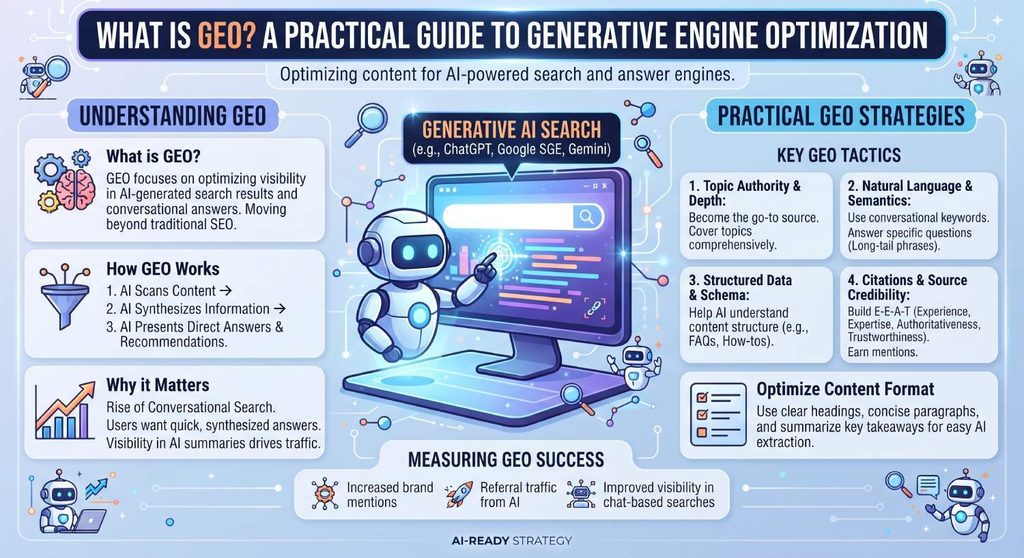
10 Things You Can Do to Improve GEO
Practical, research-backed techniques to increase the likelihood that generative engines reference, cite, and pull your content into AI-generated answers.
1. Write Direct, Extractable Answers
State clear claims early in plain language without requiring models to infer meaning from scene-setting narrative build-up.
2. Structure Content for Machine Parsing
Use headers, bullet points, numbered steps, comparison tables, and FAQ sections to make chunks of your page easier for retrieval systems to extract.
3. Back Up Claims with Specific Facts
Incorporate specific numbers, named studies, direct attribution, and dated facts that are harder for a model to reproduce without citing your page.
Top 10 GEO Action Items Matrix
| # | GEO Action Strategy | Core Implementation Focus |
|---|---|---|
| 4 | Publish Original Data & Research | Feature first-hand case studies and original data that cannot be easily reconstructed from elsewhere. |
| 5 | Build Topical Depth & Clusters | Create interlinked clusters of pages that comprehensively cover a subject to leverage topical authority and corroboration. |
| 6 | Get Cited Across the Web | Increase external mentions, guest contributions, and PR references to feed model training data and baseline knowledge. |
| 7 | Keep Technical Access Open | Audit your robots.txt and server configuration to ensure major AI crawlers (GPTBot, PerplexityBot, etc.) aren’t blocked. |
| 8 | Sharpen High-Authority Assets | Identify your most authoritative, fact-dense existing pages and optimize them first rather than starting from scratch. |
| 9 | Improve Structured Data & Signals | Add clear authorship, accurate date signals, and structured schema markup to assist machine comprehension. |
| 10 | Track Citations and Maintain SEO | Manually spot-check citations, monitor AI-referral traffic, and keep core technical SEO fundamentals completely healthy. |
Defining GEO Precisely
Generative Engine Optimization is the set of practices aimed at increasing the likelihood that AI-generated answers reference, cite, or draw from your content when responding to a relevant query.
SEO vs. GEO Focus
SEO optimizes for retrieval and ranking to get your page in front of a human scanning a list, whereas GEO optimizes for retrieval and synthesis to get your content selected as raw material by an AI model.
Origins & Research
Coined in a 2023 research paper by teams from Princeton, Georgia Tech, and the Allen Institute for AI, the field tests which content strategies genuinely improve visibility in AI-generated answers.
Interchangeable Labels
Often adopted broadly across marketing alongside related terms like AEO or LLMO, the underlying core idea remains uniform: optimize for machine comprehension and citation rather than human scanning.
How Generative Engines Actually Find and Use Your Content
To understand GEO tactics, it helps to understand — at a high level — what happens between a user’s question and the AI’s answer across retrieval, ranking, synthesis, and citation stages.
Retrieval & Ranking
Systems like AI Overviews, Perplexity, and Copilot run live searches, retrieve candidate pages, and filter them for relevance, recency, and credibility before handing passages to the model.
Synthesis & Citation
The model reads retrieved passages to generate a fluent answer, deciding which facts to include, how to phrase them, and whether to include explicit inline source links.
Two Separate Levels
GEO operates across training-time visibility (slow to change over time) and retrieval-time visibility (which specific pages get pulled into the context window for a live query).
GEO vs. SEO: Where They Overlap and Where They Diverge
It’s a mistake to treat GEO as something entirely separate from SEO. The two share a foundation, but they diverge in important ways across targeting, mechanics, and measurement.
Where They Overlap
Both disciplines reward genuinely useful, accurate content, benefit from strong technical fundamentals and crawlable architecture, rely on topical authority, and are influenced by external validation across the web.
Where They Diverge
While SEO optimizes for a ranked list humans scan top to bottom, GEO optimizes for extractable passages machines can lift cleanly out of context, favoring clear claims and defined terms over keyword stuffing.
Measurement & Signals
SEO features mature ranking signals like backlinks and clear click traffic, whereas GEO signals are still being reverse-engineered, and success is harder to measure since citations don’t always generate direct clicks.
How Can I Rank Faster on GEO?
While generative engines rely on complex training and retrieval mechanics, applying a consistent set of practical content strategies can significantly accelerate how quickly your brand gets cited.
Direct & Extractable Answers
Generative engines favor content that states clear claims early in plain language, allowing models to easily lift and cite your passages without wading through narrative fluff.
Sharpen Existing High-Authority Assets
Rather than starting from scratch, identify your most fact-dense, authoritative pages and rewrite key passages to move core answers straight to the top of sections.
Original Data & Citable Facts
Incorporate specific numbers, named studies, and original data that competitors lack, making your content a high-value source models must pull into their answers.
What Actually Seems to Improve GEO Performance
Because the field is young and proprietary systems are constantly changing, a consistent set of practices has emerged from research and practitioner testing to help content rank in AI answers.
Direct & Extractable Answers
Generative engines favor content that states a clear claim early in plain language without requiring the model to infer meaning from scene-setting narrative build-up.
Machine Parsing & Citable Facts
Headers, bullet points, and comparison tables make it easier to extract content, while specific numbers, named studies, and original data provide citable facts that are harder to replicate elsewhere.
Topical Depth & Technical Access
Build interlinked clusters of pages for topical authority and keep technical access open by ensuring your robots.txt does not block AI crawlers like GPTBot or PerplexityBot.
Where GEO Gets Measured — and Why That’s Still Hard
One of the most honest things to say about GEO right now is that measurement is immature, relying on rough signals rather than the standardized and widely available tools of classic SEO.
Manual Queries & Referrals
Practitioners rely on manually querying AI tools with target questions or monitoring referral traffic from sources like chat.openai.com and perplexity.ai in their analytics tools.
Emerging Tracking Tools
New third-party platforms are being built specifically to track brand visibility and citation frequency across AI answer engines, serving a similar function to old-school rank trackers.
Search Console Data
Marketers also watch for “AI Overview” appearances directly in Google Search Console, where Google has begun surfacing visibility data for its own AI-generated answer boxes.
Common Misconceptions About GEO
Clearing up common myths regarding AI optimization, replacement theories, keyword tactics, fixed checklists, and expected traffic outcomes.
GEO Doesn’t Replace SEO
Generative engines like Google’s AI Overviews are built on top of traditional search signals; GEO is an additional layer of optimization built on solid SEO fundamentals, not a replacement.
No Keyword Stuffing or Checklists
Engines synthesize meaning rather than matching strings, meaning stuffed phrases perform worse. Furthermore, there is no fixed checklist because different platforms weight sources differently.
Citations vs. Traffic
Citation does not guarantee direct clicks; current referral traffic from AI platforms remains a small fraction of organic search, making brand visibility and trust the primary near-term value.
Better to Focus on SEO or GEO?
Treating SEO and GEO as an either/or choice is a mistake; GEO is better understood as an additional layer of optimization built on top of solid SEO fundamentals, not a replacement.
SEO Remains the Foundation
Many generative answer engines, including Google’s AI Overviews, are built substantially on top of traditional search indexing and ranking systems.
The Risk of Ignoring SEO
A page that doesn’t rank or get crawled well in classic search is unlikely to be retrieved for GEO purposes either, making core technical health mandatory.
GEO as the Next Layer
Once your SEO fundamentals are secure, GEO adapts your content for extractability and machine parsing to ensure you get cited in modern AI summaries.
How Different Platforms Approach This Differently
Treating “AI search” as one monolithic target is a common mistake; major platforms behave quite differently, meaning a tactic that works well on one may do little on another.
Google’s AI Overviews
Google’s AI Overviews sit directly on top of existing search ranking systems, meaning pages that already rank well organically are far more likely to be pulled into the AI summary.
Perplexity & ChatGPT
Perplexity draws from a diverse set of sources where specialist sites punch above their weight, while ChatGPT relies on training-time visibility or live browsing depending on active settings.
Microsoft Copilot
Built on top of Bing’s index, Copilot tends to favor sources that perform well in Bing’s own search rankings, which reward slightly different technical signals than Google.
Industry-Specific Considerations
GEO’s practical impact varies significantly by industry, largely based on how often people ask AI systems direct factual questions versus making complex, personal, or high-stakes purchase decisions.
Informational Content
Explainers, how-to guides, and definitions tend to be heavily absorbed into AI-generated answers, resulting in sharp traffic declines and making citations vital for visibility.
Transactional & Local
Comparison-shopping sits in a middle zone where users still click through for complex purchases, while local and highly personal queries remain less disrupted due to map-based results.
Affiliate Sites at Risk
Affiliate-driven sites sit in an exposed position since lost click-throughs mean lost commissions, making GEO an immediate necessity rather than optional experimentation.
A Practical Starting Checklist
If you’re beginning to think about GEO for an existing site, a reasonable starting sequence involves auditing crawler access, sharpening top assets, and tracking citations.
Audit & Prioritize Assets
Check whether your robots.txt allows major AI crawlers, then identify and sharpen your highest-authority, most fact-dense pages rather than starting completely from scratch.
Extractability & Structure
Rewrite key passages for direct extractability by moving core answers to the top of sections, adding structured data, and including clear authorship and date signals.
Data, Tracking & SEO
Leverage original data or expertise competitors lack, track AI-referral traffic, manually spot-check citations, and keep your core SEO fundamentals healthy.
Where This Is Heading
The honest state of the field is that GEO is real, increasingly important, and still genuinely unsettled as platforms iterate quickly and opaquely on their citation mechanics.
Unsettled Platform Iteration
AI platforms driving this shift are iterating on their retrieval and citation mechanics quickly and mostly opaquely, meaning the exact rules continue to evolve.
The Stable Underlying Principle
What remains stable is that content which is clear, well-structured, original, well-corroborated across the web, and technically accessible is well-positioned no matter how platform mechanics change.
An Evolving Discipline
For anyone whose business depends on being found, GEO isn’t a fad; it’s the next layer of a discipline evolving for decades, rewarding businesses that adapt early.
10 Most Frequent Questions About GEO
Direct answers to the most common questions marketers and publishers ask about generative engine optimization, platform mechanics, and performance measurement.
1. What Is GEO?
Generative Engine Optimization is the set of practices aimed at increasing the likelihood that AI-generated answers reference, cite, or draw from your content when responding to a relevant query.
2. Does GEO Replace SEO?
No. GEO is better understood as an additional layer of optimization built on top of solid SEO fundamentals, because many generative engines are built directly on top of traditional search indexing.
3. How Do Generative Engines Find Content?
They use retrieval-augmented generation (RAG) by running live searches, retrieving candidate pages, filtering for relevance, and feeding clean passages into the model for synthesis.
Top 10 GEO Questions Matrix
| # | Frequently Asked Question | Core Answer / Detail |
|---|---|---|
| 4 | What is the origin of GEO? | Coined in a 2023 research paper by teams from Princeton, Georgia Tech, and the Allen Institute for AI. |
| 5 | Is GEO just keyword stuffing? | No, generative engines synthesize meaning; artificially stuffed phrases perform worse than clear, useful content. |
| 6 | How do different platforms behave? | Google relies on traditional rankings, Perplexity draws from diverse sources, and ChatGPT uses training data or browsing. |
| 7 | Which industries are most impacted? | Informational content and affiliate-driven sites experience sharp traffic shifts and face the highest stakes. |
| 8 | How can I improve performance? | Write direct extractable answers, back up claims with original facts, and structure content for machine parsing. |
| 9 | How is GEO measured? | Measurement relies on rough signals like manual queries, AI referral traffic, emerging tracking tools, and Search Console. |
| 10 | Does citation guarantee clicks? | No, citations do not guarantee direct traffic; current referral traffic remains a small fraction compared to brand visibility. |